American Innovations on the 2025 Civics Test: Light Bulb to Moon Landing (Q118)
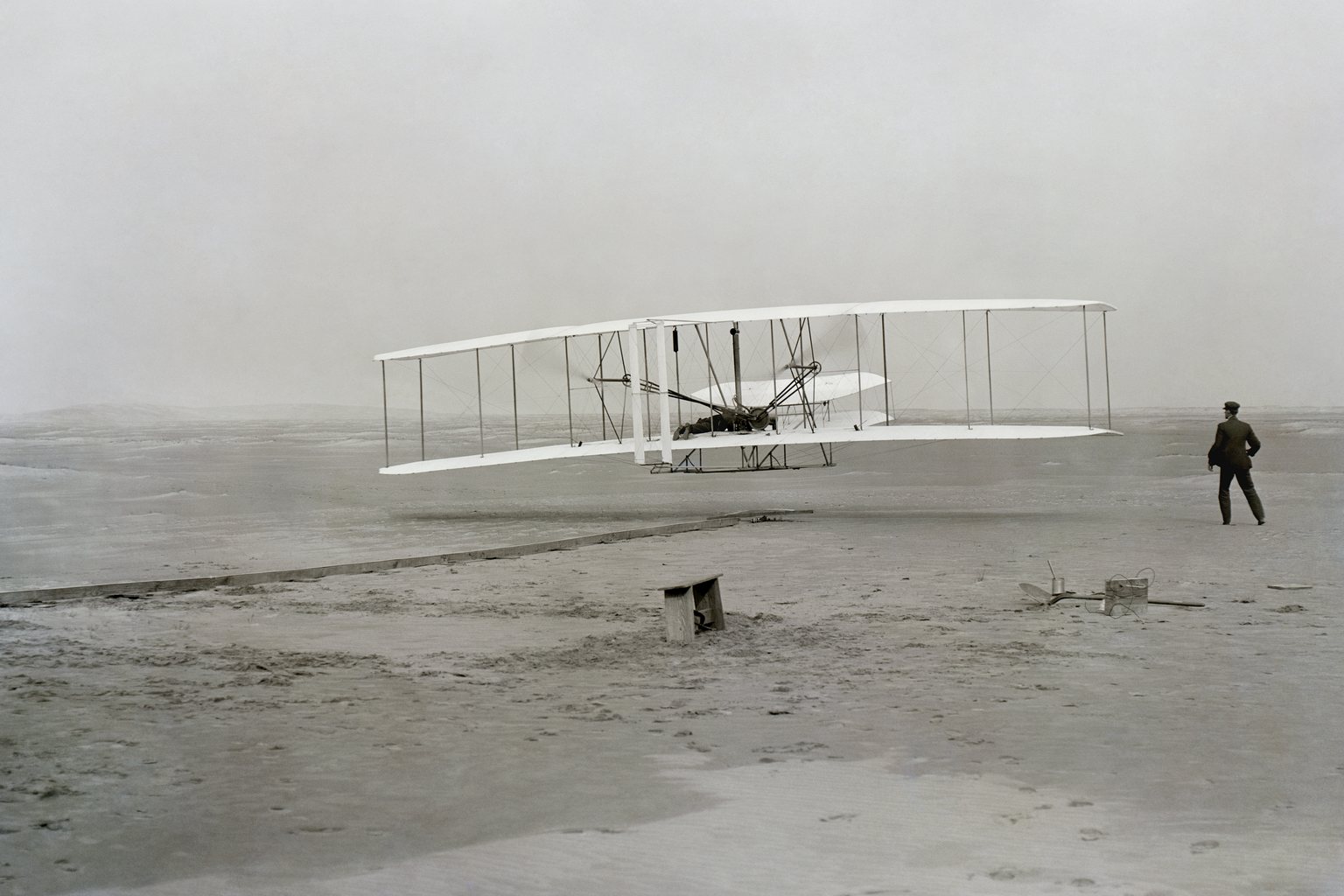
One of the friendliest questions on the 2025 Naturalization Civics Test is in the Symbols block: Name one example of an American innovation (Q118). There are seven accepted answers, you only need one, and most of them are things you use or see every day. The photo above shows one of them: the first airplane flight, by Orville and Wilbur Wright at Kitty Hawk, North Carolina, on December 17, 1903. Orville is at the controls; Wilbur is standing on the sand.
Name one example of an American innovation (Q118)
Accepted answers, from the official USCIS list:
- Light bulb
- Automobile (cars, internal combustion engine)
- Skyscrapers
- Airplane
- Assembly line
- Landing on the moon
- Integrated circuit (IC)
Any one is enough. If English pronunciation worries you, pick a short, clear word you can say with confidence: airplane or light bulb are good choices.
A one-line story for each answer
Stories are easier to remember than lists. These dates are study context only; on the test, just say the innovation.
- Light bulb. In 1879, Thomas Edison’s team in Menlo Park, New Jersey, built a long-lasting electric light bulb that made electric lighting practical for homes and cities.
- Automobile. People in several countries built early cars, but American companies made them a product for ordinary families. Henry Ford’s Model T (1908) was one of the first cars many workers could afford.
- Skyscrapers. Steel frames let buildings grow very tall. Chicago’s Home Insurance Building (1885) is often called the first skyscraper, and New York and Chicago skylines followed.
- Airplane. The Wright brothers made the first powered, controlled airplane flight in 1903. That first flight lasted about 12 seconds and went 120 feet.
- Assembly line. In 1913, Ford’s factory in Highland Park, Michigan, started a moving assembly line: the car moved past workers, and each worker did one job. Building a car became much faster and cheaper.
- Landing on the moon. On July 20, 1969, NASA’s Apollo 11 landed on the moon, and Neil Armstrong and Buzz Aldrin became the first people to walk there.
- Integrated circuit (IC). An integrated circuit, or microchip, puts many electronic parts on one small piece of material. Jack Kilby (1958) and Robert Noyce (1959) developed early versions. Chips run today’s phones and computers.
Memory trick: walk through a normal day. You switch on a light bulb, drive a car past skyscrapers, fly on an airplane, buy things made on an assembly line, look up at the moon, and check a phone full of integrated circuits.
Connect it: Benjamin Franklin, inventor (Q85)
Innovation also appears in the Colonial Period block. Benjamin Franklin is famous for many things. Name one (Q85). One accepted answer is simply “Inventor.” Franklin invented the lightning rod, which protects buildings from lightning. Other accepted answers include U.S. diplomat, first Postmaster General of the United States, helped write the Declaration of Independence, and founded the first free public libraries. More in the Federalist Papers and Benjamin Franklin.
Do not mix them up. Q118 wants a thing (like “airplane”). Q85 wants something about Franklin (like “inventor”). Saying “Wright brothers” or “Edison” for Q118 is a person, not the innovation, so answer with the innovation itself.
One-minute review
| Question | Say this |
|---|---|
| Q118 — an American innovation | Airplane (or light bulb, automobile, skyscrapers, assembly line, landing on the moon, integrated circuit) |
| Q85 — Benjamin Franklin is famous for | Inventor (or U.S. diplomat, first Postmaster General, helped write the Declaration, founded free public libraries) |
Study these related questions
- Symbols and Holidays — A: Symbols: Q118 in context, with audio
- American History — A: Colonial Period and Independence: Q85 in context
- American symbols: the flag and the national anthem: more questions from the same Symbols block
- Free scored practice test: 20 questions like the interview, 12 correct to pass
This is an evergreen study post. The answers come from the official USCIS 128 Civics Questions and Answers (2025 version), used for Form N-400 filed on or after October 20, 2025 (USCIS Policy Manual, Vol. 12, Part E, Ch. 2). Not sure which test you will take? See Which civics test: 2008 vs 2025. Check USCIS Check for Test Updates for answers that change with elections.
This post summarizes public USCIS civics materials for educational study. It is not legal advice.