Checks and Balances, Explained: Who Checks Whom on the 2025 Civics Test (Q15)
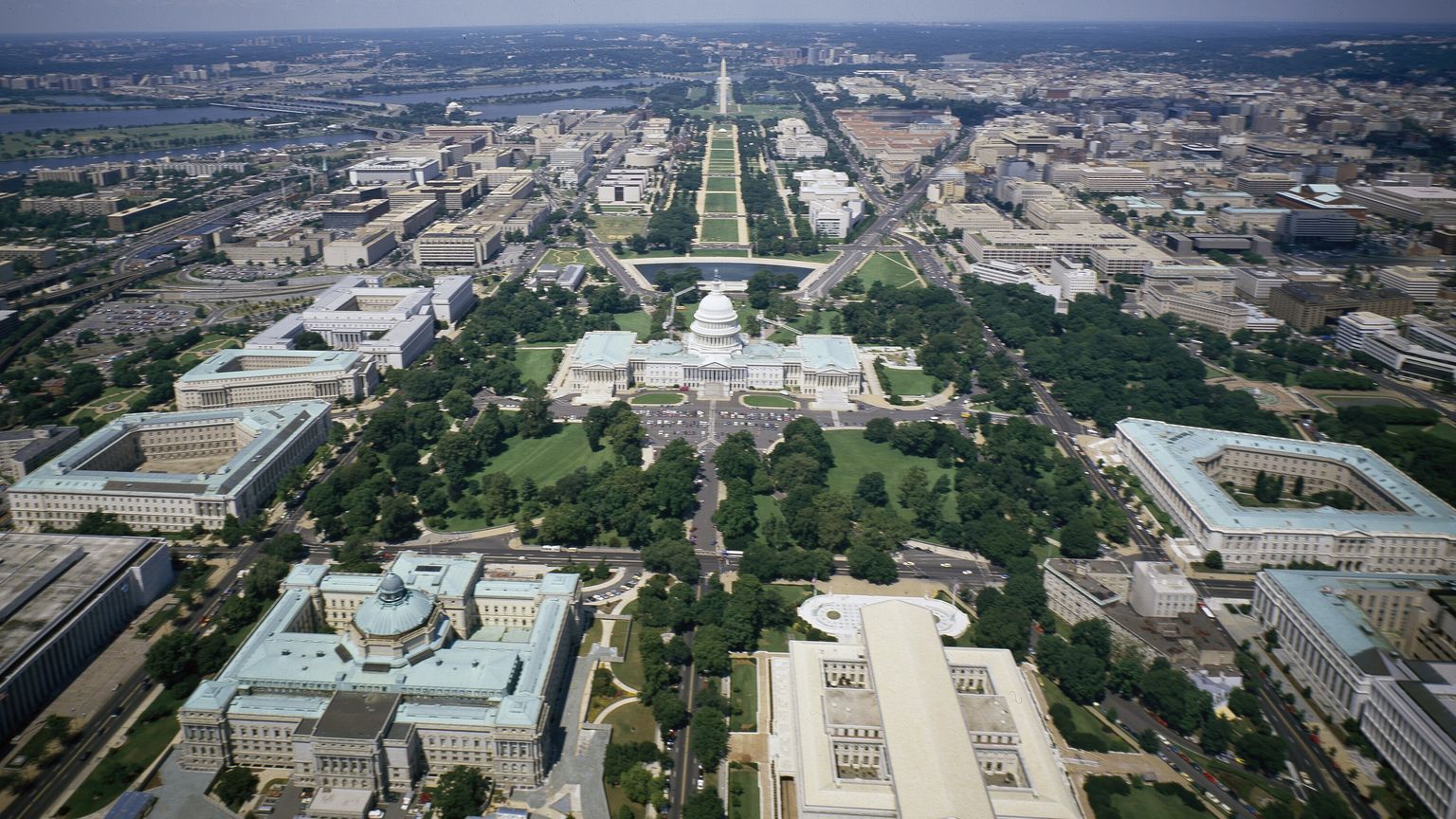
One idea runs through a big part of the civics test: no one in the U.S. government gets to do everything alone. Congress, the President and the courts each hold some power, and each can slow down or stop the other two. That idea is called checks and balances, and it is the answer to Q15.
From the air you can almost see it. In the photo above, the Capitol (Congress) sits in the middle, and the Supreme Court is right across the street. The White House is about a mile and a half away, near the Washington Monument end of the Mall. Three buildings, three branches, and none of them is in charge of the others.
The question and the answers
Q15. There are three branches of government. Why? Any one of these is accepted (USCIS 128 questions PDF):
- So one part does not become too powerful
- Checks and balances
- Separation of powers
Easiest to say: “Checks and balances.” Three words, and it is the exact wording on the USCIS list.
Taking the 2008 test (N-400 filed before Oct. 20, 2025)? The same idea is asked another way: “What stops one branch of government from becoming too powerful?” Answer: checks and balances or separation of powers (USCIS 100 questions PDF). Not sure which test you take? See Which Civics Test Am I Taking?
Two words, two ideas
- Separation of powers means the jobs are split up. The Constitution gives each branch its own article: Article I is Congress (makes laws), Article II is the President (carries out laws), and Article III is the courts (explain laws). That’s Q16: legislative, executive and judicial.
- Checks and balances means each branch has tools to stop the others. Splitting power is not enough. Each part also needs a way to say “no.”
A simple picture: three people share one car. One holds the keys, one has the map, and one pays for gas. Nobody can take a trip without the other two.
Who checks whom: the one-page map
| Branch | Checks the President by… | Checks Congress by… | Checks the courts by… |
|---|---|---|---|
| Congress (Legislative) | Overriding a veto with a two-thirds vote in both houses; the Senate approving (or rejecting) Cabinet members, judges and treaties; impeachment; controlling the money (the budget) | — | The Senate confirming (or rejecting) judges; impeaching judges; proposing amendments to the Constitution; creating the lower federal courts |
| President (Executive) | — | Vetoing bills | Appointing federal judges, including Supreme Court justices; granting pardons |
| Courts (Judicial) | Deciding that an action of the President goes against the Constitution | Deciding that a law goes against the Constitution (judicial review) | — |
Every box in this table comes from the U.S. Constitution: the veto and override are in Article I, Section 7; impeachment in Article I, Sections 2 and 3; spending money only “in Consequence of Appropriations made by Law” in Article I, Section 9; appointments, treaties and pardons in Article II, Section 2; lower courts and judges serving “during good Behaviour” in Article III, Section 1; and amendments in Article V.
Six checks to remember, with real examples
1. The President can veto. Congress can override. The President can refuse to sign a bill (Q44). Congress can still make it law with a two-thirds vote in both the House and the Senate. Overrides are rare and hard. Full details: How a Bill Becomes a Law: Signing, Vetoes and Judges.
2. The President picks judges. The Senate says yes or no. The President appoints federal judges (Q45), but only “by and with the Advice and Consent of the Senate.” The same is true for Cabinet secretaries and ambassadors, and treaties need two-thirds of the senators present.
3. Congress holds the money. Congress “makes the federal budget” (Q20). The executive branch can only spend what Congress approves by law. Congress also “declares war” (another Q20 answer), even though the President is Commander in Chief (Q42).
4. Impeachment. The House can impeach (formally charge) the President, a judge or another federal officer. The Senate then holds a trial, and it takes two-thirds of the senators present to convict and remove someone. When the President is on trial, the Chief Justice presides.
5. The courts can strike down laws and actions. One answer to Q51, “What does the judicial branch do?”, is “Decides if a law goes against the (U.S.) Constitution.” The Supreme Court claimed this power, called judicial review, in Marbury v. Madison (1803). Courts also check the President: in Youngstown Sheet & Tube Co. v. Sawyer (1952), the Court ruled that President Truman could not take over the nation’s steel mills without a law from Congress. In United States v. Nixon (1974), it ordered President Nixon to hand over the White House tapes.
6. Judges are protected so they can say no. Federal judges serve “during good Behaviour,” which in practice means for life (Q55), and Congress cannot cut their pay while they serve. Why? Q56: “To be independent (of politics).” A judge who can’t be fired for an unpopular ruling can check the other two branches.
The 10 other test answers this idea unlocks
Once checks and balances “clicks,” these answers stop being random facts:
| Question | Answer | The check behind it |
|---|---|---|
| Q13 What is the rule of law? | No one is above the law. | Leaders and the government must obey the law too. |
| Q16 Name the three branches. | Legislative, executive, and judicial | Separation of powers |
| Q20 Name one power of Congress. | Makes the federal budget / Declares war | Congress controls money and war |
| Q26 Why do House members serve two years? | To more closely follow public opinion | Voters check Congress often |
| Q37 Why can the President serve only two terms? | To keep the president from becoming too powerful (22nd Amendment) | A time limit on power |
| Q41 Name one power of the President. | Vetoes bills / Appoints federal judges | The President’s checks |
| Q44 Who vetoes bills? | The President | Check on Congress |
| Q45 Who appoints federal judges? | The President | Check on the courts |
| Q51 What does the judicial branch do? | Decides if a law goes against the Constitution | Judicial review |
| Q56 Why do justices serve for life? | To be independent (of politics) | Protects the courts’ check |
There’s a fourth “check” that isn’t a branch at all: the people. Voters elect the President, every senator and every representative, and the federal government shares power with the states (Q58–Q60). For that side of the story, read Federal vs. State Powers.
Watch out for these traps
- “The Supreme Court is in charge of the President.” No. No branch is “in charge.” Each one can block certain actions of the others.
- “Congress can fire the President whenever it wants.” No. Removal needs impeachment by the House and a two-thirds vote to convict in the Senate.
- Mixing up Q15 and Q13. Q15 is about the branches (checks and balances). Q13 is about everyone following the law (rule of law).
- Saying “democracy” for Q15. It sounds right, but it is not an answer on the list. Stick to the USCIS words.
Quick self-check
Say each answer out loud before you open the box.
- There are three branches of government. Why?
- Who can stop a bill by vetoing it?
- How can Congress still pass a bill after a veto?
- Which part of Congress approves federal judges?
- Which branch decides if a law goes against the Constitution?
- Why do Supreme Court justices serve for life?
- Checks and balances (or: separation of powers; so one part does not become too powerful). (Q15)
- The President. (Q44)
- With a two-thirds vote in both the House and the Senate (veto override).
- The Senate.
- The judicial branch (the courts, the Supreme Court). (Q51)
- To be independent (of politics) / to limit outside political influence. (Q56)
Questions 3 and 4 are not on the USCIS list. They are here to help you understand the answers that are.
Study these next
- Practice the whole System of Government section: American Government B
- Hear the questions read out loud: Listen
- Related: The Three Branches of Government · Who Does What? Congress, the President and the Courts · The Supreme Court on the 2025 Civics Test · Presidential Succession (Q40)
- Ready to test yourself? Take a practice test.
Sources: USCIS, 2025 Civics Test, 128 Questions and Answers (PDF) (Q13, Q15, Q16, Q20, Q26, Q37, Q41–Q45, Q51, Q55, Q56); USCIS, 100 Civics Questions and Answers, 2008 version (PDF); USCIS, Study for the Test; National Archives, The Constitution of the United States: A Transcription (Art. I §§2, 3, 7, 9; Art. II §2; Art. III §1; Art. V); National Archives, Marbury v. Madison (1803); Youngstown Sheet & Tube Co. v. Sawyer, 343 U.S. 579 (1952); United States v. Nixon, 418 U.S. 683 (1974). Photo: Carol M. Highsmith, Library of Congress, via Wikimedia Commons (public domain).
This post is general study information, not legal advice. CitizenExams is an independent study site and is not affiliated with USCIS.