Citizenship Through Marriage: The 3-Year Rule Explained
Most green card holders wait 5 years before they can apply for U.S. citizenship. If you are married to a U.S. citizen, the wait can be 3 years. This is the spousal rule in section 319(a) of the Immigration and Nationality Act. It is not automatic, though: marriage alone does not make anyone a citizen, and the 3 years only count if several things are true at the same time.
Here is what USCIS requires, in plain English, based on the USCIS Policy Manual, Volume 12, Part G.
The checklist for the 3-year path
On the day you file Form N-400, you must be:
| Requirement | What it means |
|---|---|
| 18 or older | Age 18 at the time of filing. |
| A green card holder | A lawful permanent resident (LPR) at the time of filing. |
| 3 years as a permanent resident | Continuous residence in the United States as an LPR for at least 3 years right before you file, and up to the oath. |
| 3 years living in “marital union” | Married to and living with your U.S.-citizen spouse for at least the 3 years right before you file. |
| A spouse who was a citizen the whole time | Your spouse must have been a U.S. citizen for those same 3 years. |
| 18 months in the U.S. | Physical presence of at least 18 months (548 days) in the United States during those 3 years. |
| 3 months in your state or district | Living in the state or USCIS district where you file for at least 3 months before filing. |
| English and civics | Pass the English test and the civics test (or qualify for an exception). |
| Good moral character | For at least the 3 years before filing, up to the oath. |
| Attachment to the Constitution | Support the principles of the U.S. Constitution. |
If you do not meet the 3-year rule, you can still apply under the general 5-year rule, like any other permanent resident.
Three dates that must all line up
The 3-year rule trips people up because it is really three separate clocks, and all three must reach 3 years:
- Your green card clock: 3 years since you became a permanent resident (the “resident since” date on your card).
- Your marriage clock: 3 years married and living together.
- Your spouse’s citizenship clock: 3 years since your spouse became a citizen (if your spouse was born a citizen, this one is already done).
Example. Ana married Ben in 2020, when Ben was still a green card holder. Ana got her own green card in 2021, and Ben became a U.S. citizen in 2023. By 2024, Ana has had her green card for 3 years and has been married for 4 years, but Ben has only been a citizen for 1 year. Ana’s marriage only “counts” for the 3-year rule from the day Ben became a citizen, so she must wait until 2026. (In 2026 she would also reach the 5-year mark, so either path would work for her.)
USCIS allows you to file up to 90 days early based on the green card clock, but the marriage and citizenship clocks must already be complete on the filing day. See our 90-day early filing guide and date calculator.
“Living in marital union”: what it means
USCIS says you are living in marital union when you and your citizen spouse actually live together. The Policy Manual (Part G, Chapter 2) lists these situations:
- Living apart when you file (or during the 3 years) means you generally do not meet the requirement. There are limited exceptions, which USCIS looks at case by case.
- Divorce or annulment before the oath ends eligibility under the spousal rule, whether it happens before or after you file.
- Death of the citizen spouse before the oath also ends eligibility under this rule. There is a special provision for surviving spouses of U.S. citizens who died during honorable active-duty military service.
- If your spouse loses U.S. citizenship before your oath, you are no longer eligible under this rule.
- Marrying another U.S. citizen later does not “carry over” the time from an earlier marriage.
One important detail: the living-together requirement covers the 3 years before filing. After you file, USCIS requires that the legal marriage continue until you take the Oath of Allegiance.
If any of these applies to you, you may still qualify under the 5-year rule. A qualified immigration attorney or a DOJ-accredited representative can look at your exact facts (how to find free or low-cost help).
If your citizen spouse abused you: USCIS has an exception. People who were subjected to battery or extreme cruelty by their U.S.-citizen spouse, and who got their green card through the related protections, do not have to be married to or living with that spouse to use the 3-year rule (Part G, Chapter 3).
If you have a conditional (2-year) green card
Many spouses first get a conditional green card, valid for 2 years, and then file Form I-751 to remove the conditions. According to the Policy Manual, Part G, Chapter 5:
- Your time as a conditional resident counts toward the 3 years of continuous residence and physical presence.
- USCIS cannot approve your N-400 while your I-751 is still pending. If the I-751 is pending when you file or when you are interviewed, USCIS will decide the I-751 first or at the same time as the N-400.
Documents to send with the N-400
For the marriage path, the USCIS Document Checklist (Form M-477) lists four items. Always check the current Form N-400 instructions too.
- Proof your spouse has been a U.S. citizen for the last 3 years: a U.S. birth certificate, Certificate of Naturalization, Certificate of Citizenship, the inside front cover and signature page of your spouse’s current U.S. passport, or Form FS-240 (Consular Report of Birth Abroad).
- Your current marriage certificate.
- Proof that all of your spouse’s earlier marriages ended (divorce decrees, annulments or death certificates). Send the same for your own earlier marriages, if any.
- Documents that show your life together: for example joint tax returns, bank accounts, leases, mortgages or your children’s birth certificates, or IRS-certified tax returns or tax return transcripts for the past 3 years.
Bring originals of these documents to your interview. Our interview document checklist covers the rest.
The tests are the same
The 3-year rule only changes when you can apply. It does not make the tests easier. You still take the English test and the civics test at your interview. If you file Form N-400 on or after October 20, 2025, you take the 2025 civics test: up to 20 questions from a list of 128, and you need 12 correct to pass (USCIS 2025 Civics Test). If you filed earlier, you take the 2008 test. Not sure? Read Which Civics Test Am I Taking?
A tip for couples: your U.S.-citizen spouse can be your best study partner. Ask them to quiz you for 10 minutes a day with the practice test or Listen, and switch roles so they read the question and you answer out loud, the way the officer will ask it.
Quick self-check
- Do you need to be married to a U.S. citizen for 3 years, or just have your green card for 3 years?
- Your spouse became a citizen 2 years ago. Can you use the 3-year rule today?
- Does time on a conditional green card count?
- Does the 3-year rule change which civics test you take?
- Both. 3 years as a permanent resident and 3 years married to and living with your spouse while your spouse was a U.S. citizen.
- Not yet. Your spouse must have been a citizen for the full 3 years. You may still qualify under the 5-year rule.
- Yes, it counts toward continuous residence and physical presence. Your I-751 must be approved before or together with your N-400.
- No. The test depends on your N-400 filing date (2025 test if filed on or after Oct. 20, 2025).
Read next
- Continuous Residence vs Physical Presence for Form N-400
- Traveling Abroad Before or After You File Form N-400
- Good Moral Character for Citizenship
- Can You Change Your Name When You Become a U.S. Citizen?
- N-400 Fee Waiver or Reduced Fee: Who Qualifies
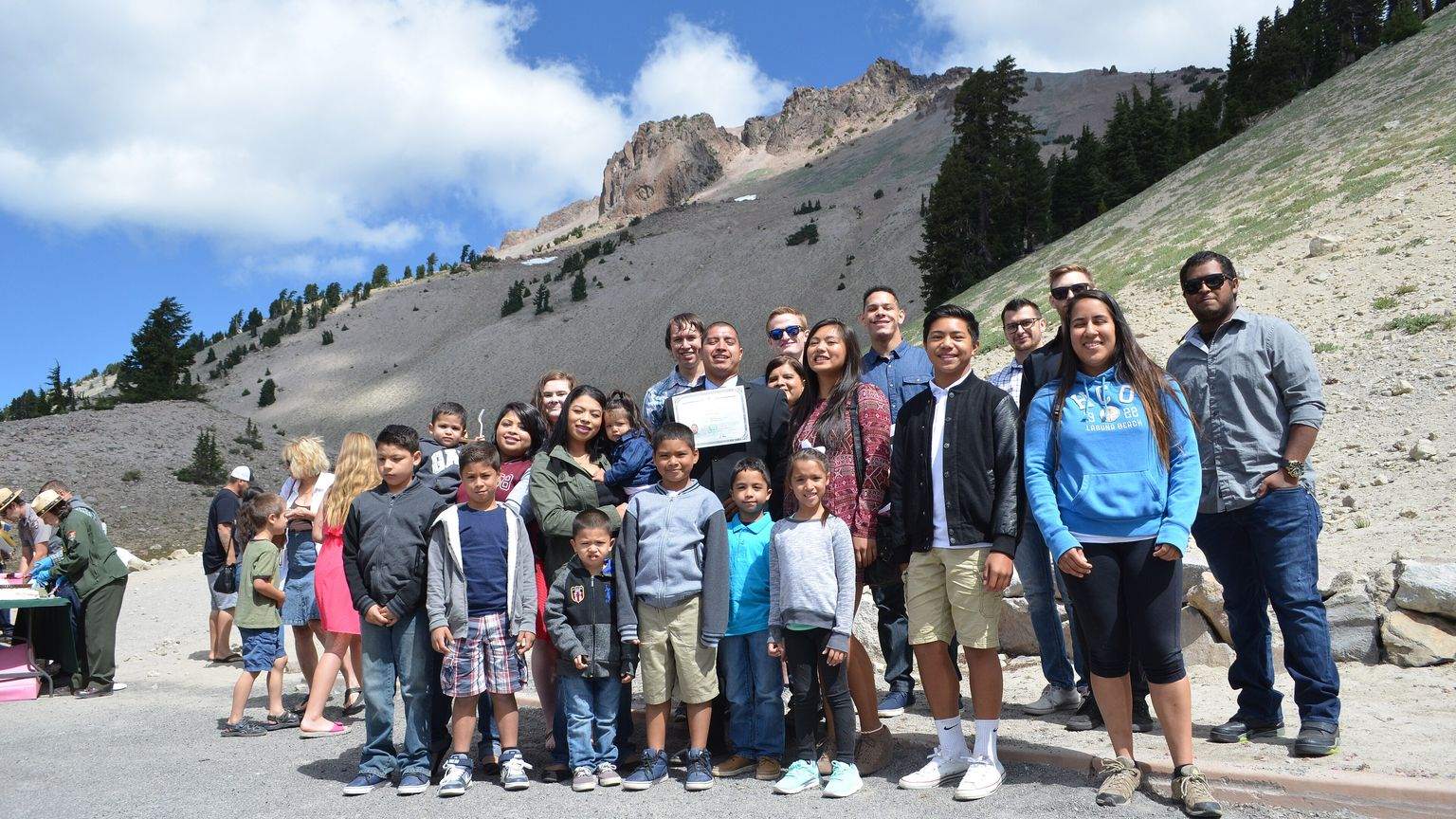
Sources: USCIS Policy Manual, Volume 12 (Citizenship and Naturalization), Part G (Spouses of U.S. Citizens): Chapter 2, Marriage and Marital Union for Naturalization, Chapter 3, Spouses of U.S. Citizens Residing in the United States and Chapter 5, Conditional Permanent Resident Spouses and Naturalization; USCIS, Form M-477, Document Checklist (PDF); USCIS, Form N-400, Application for Naturalization; USCIS, 2025 Civics Test. Photo: Lassen Volcanic National Park (National Park Service), via Wikimedia Commons (public domain).
This post is general information, not legal advice. CitizenExams is an independent study site and is not affiliated with USCIS.