The Civics Test History Timeline: 1607 to 2001 in One Page (Q73–Q117)
History is a story, not a list. The American History part of the 2025 civics test (questions 73 to 117) looks scary as 45 separate questions. Put them on one timeline and they snap together: colonies → revolution → Constitution → a growing country → Civil War → two World Wars → Cold War → civil rights → September 11.
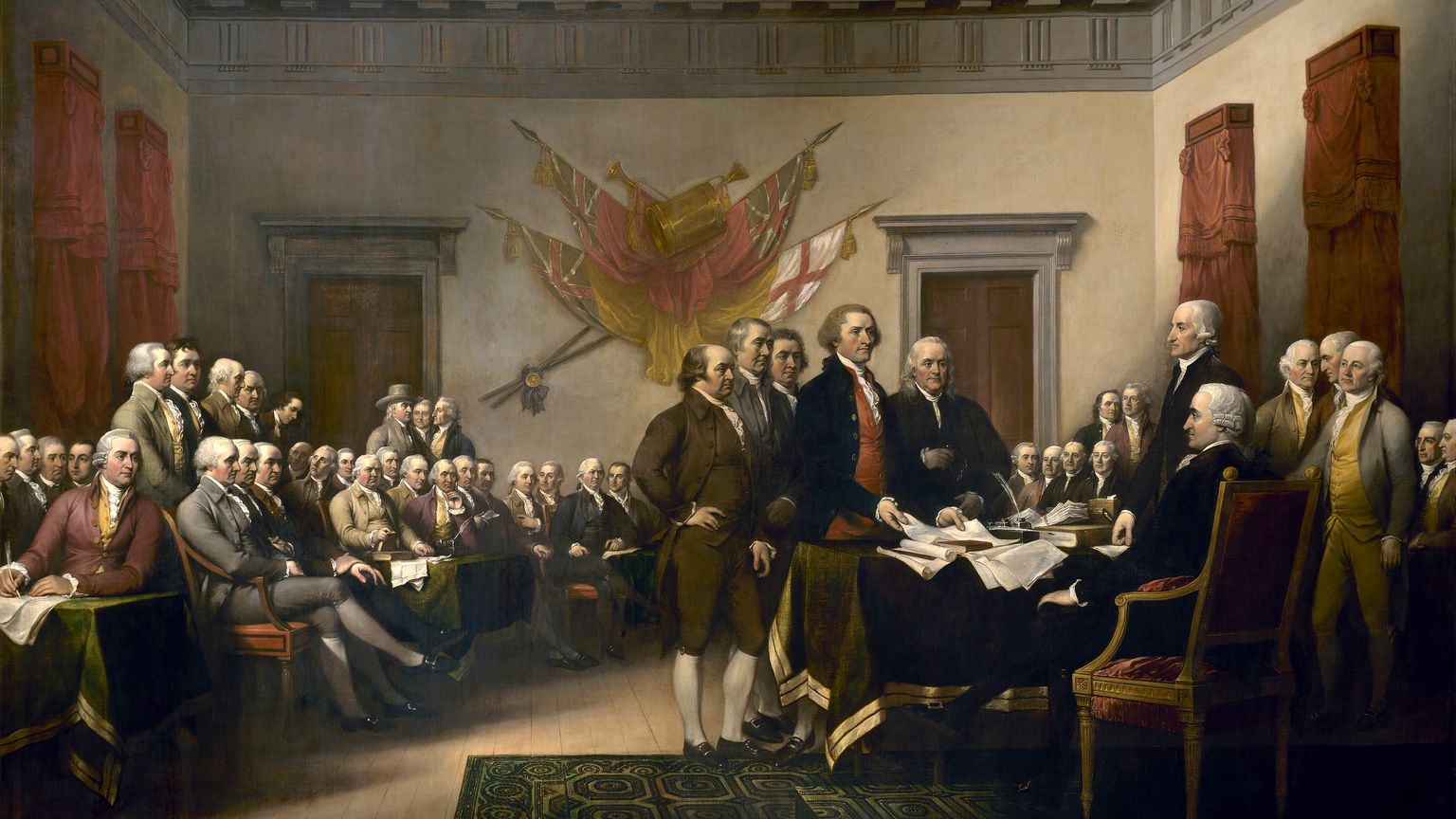
The painting above is a good place to start. It shows the committee presenting the Declaration of Independence in 1776, and it hangs in the U.S. Capitol. (Fun fact: it is also on the back of the $2 bill.)
How to use this page: read the timeline once, top to bottom, out loud. Then try the “Which came first?” quiz at the end. Dates are only memory pegs. At the interview, the officer wants the answer from the USCIS list, like “July 4, 1776” or “the Civil War”, not a history lecture (USCIS: 2025 Civics Test).
Quick reminder: on the 2025 test the officer asks up to 20 of the 128 questions, and you pass with 12 correct. Questions marked ★ are among the 20 starred questions for applicants 65 or older with 20 years as a permanent resident. Not sure which test is yours? See Which Civics Test Am I Taking?
Before 1776: the colonies
| When | What happened | Test question → answer |
|---|---|---|
| Thousands of years before 1492 | People already lived across the land | Q74 ★ Who lived in America before the Europeans arrived? → American Indians / Native Americans |
| 1607 | Jamestown, Virginia: the first lasting English colony | Q73 Why did colonists come? → freedom, religious freedom, economic opportunity, escape persecution |
| 1619 onward | Enslaved Africans brought to the English colonies | Q75 Who was taken and sold as slaves? → Africans / people from Africa |
| 1765–1774 | Stamp Act, Boston Massacre (1770), Boston Tea Party (1773), Intolerable Acts | Q77 Why did Americans declare independence? → taxation without representation, high taxes, Boston Tea Party, and more |
Memory peg: “No taxation without representation” is the slogan that leads straight into 1776. Deeper dive: Why Colonists Came to America (Q73, Q75) and Native Americans and American Indian Tribes.
1775–1789: revolution and a new government
| When | What happened | Test question → answer |
|---|---|---|
| 1775–1783 | The war for independence | Q76 → American Revolution / Revolutionary War / War for Independence |
| June 1775 | Battle of Bunker Hill | Q80 Name one event → Bunker Hill |
| July 4, 1776 | Declaration of Independence adopted | Q79 → July 4, 1776; Q78 ★ Who wrote it? → (Thomas) Jefferson |
| Dec 1776 – 1781 | Washington crosses the Delaware (Trenton), Saratoga, Valley Forge, British surrender at Yorktown | Q80 → any one of these |
| 1776–1783 | The original 13 states | Q81 Name five → e.g. New York, Virginia, Pennsylvania, Massachusetts, Georgia |
| 1787 | The Constitution is written in Philadelphia | Q82 → (U.S.) Constitution |
| 1787–1788 | The Federalist Papers argue for it | Q83 → Madison, Hamilton, Jay, Publius; Q84 → they supported passing the Constitution |
| 1789 | George Washington becomes the first president | Q86 ★ → first president, “Father of Our Country” |
Memory peg: 76 → 87. First the Declaration (1776), eleven years later the Constitution (1787). “Seventy-six, we’re free; eighty-seven, the rules.” Founders cheat sheet: Jefferson, Madison and Hamilton and the Federalist Papers and Benjamin Franklin.
1800s: a bigger country, then a divided one
| When | What happened | Test question → answer |
|---|---|---|
| 1803 | Jefferson buys land from France | Q90 → Louisiana Territory; Q87 Jefferson → doubled the size of the U.S. |
| 1812–1815 | War of 1812 (Madison is president) | Q91 → War of 1812; Q88 Madison → president during the War of 1812 |
| 1846–1848 | Mexican-American War | Q91 → Mexican-American War |
| 1848 | Seneca Falls women’s rights meeting | Q99 → Elizabeth Cady Stanton, Lucretia Mott, Susan B. Anthony, and others |
| 1861–1865 | War between the North and the South | Q92 → the Civil War; Q96 What war ended slavery? → the Civil War |
| 1861–1865 | Fort Sumter, Antietam, Gettysburg, Vicksburg, Sherman’s March, Appomattox | Q93 → any one event |
| Jan 1, 1863 | Lincoln issues the Emancipation Proclamation | Q95 → freed slaves in the Confederacy / freed the slaves |
| April 1865 | The war ends; Lincoln is assassinated | Q94 ★ Lincoln → saved the Union, freed the slaves, led the U.S. during the Civil War |
| 1868 | 14th Amendment | Q97 → 14th Amendment (citizenship for all persons born or naturalized here) |
| 1870 | 15th Amendment | Q98 When did all men get the right to vote? → 1870 / after the Civil War / 15th Amendment |
| 1898 | Spanish-American War | Q91 → Spanish-American War |
Memory peg: the 1800s wars in order are “1812, Mexico, Civil, Spain.” Any one of them answers Q91. More: Civil War, Lincoln and Emancipation and The Louisiana Purchase.
1900s: world wars, the Depression and the Cold War
| When | What happened | Test question → answer |
|---|---|---|
| 1917 | The U.S. enters World War I | Q101 Why? → Germany attacked U.S. (civilian) ships |
| 1920 | 19th Amendment | Q102 When did all women get the right to vote? → 1920 / after World War I / 19th Amendment |
| 1929 | Stock market crash | Q104 → stock market crash of 1929; Q103 → longest economic recession in modern history |
| 1933–1945 | Franklin Roosevelt is president | Q105 → (Franklin) Roosevelt |
| Dec 7, 1941 | Japan attacks Pearl Harbor | Q106 Why did the U.S. enter WWII? → Pearl Harbor |
| 1947–1991 | Cold War with the Soviet Union | Q108 → Soviet Union / USSR / Russia; Q109 → communism, nuclear war |
| 1950–1953 | Korean War | Q110 → to stop the spread of communism |
| 1953–1961 | Eisenhower is president; Interstate highways law in 1956 | Q107 → WWII general, 34th president, Interstate System |
| 1950s–1960s | The civil rights movement | Q112 → fought to end racial discrimination; Q113 ★ Martin Luther King, Jr. → fought for civil rights |
| 1960s–1975 | Vietnam War | Q111 → to stop the spread of communism |
| 1990–1991 | Persian Gulf War | Q114 → to force the Iraqi military from Kuwait |
Memory pegs: “17 in, 20 vote.” The U.S. joined World War I in 1917, and women won the vote in 1920. Then “29 crash, 41 attack.” Korea and Vietnam share one answer: to stop the spread of communism. Learn it once, use it twice. More: Why the U.S. Entered Wars, The Great Depression, The Cold War and MLK and the Civil Rights Movement.
2001 and after
| When | What happened | Test question → answer |
|---|---|---|
| Sept 11, 2001 | Terrorist attacks on New York, the Pentagon and United Flight 93 | Q115 ★ → terrorists attacked the United States |
| 2001 onward | Wars after the attacks | Q116 → (Global) War on Terror, War in Afghanistan, War in Iraq |
The shortest safe answer for Q115 is the first one on the list: “Terrorists attacked the United States.” More: U.S. Wars of the 1800s and 1900s, and September 11.
Not on a date line, but still history
A few history questions are about people or groups more than dates. Learn them as “who’s who”:
- Q85 Benjamin Franklin → inventor, diplomat, first Postmaster General, first free public libraries
- Q89 Alexander Hamilton → first Secretary of the Treasury
- Q100 a war of the 1900s → World War I, World War II, Korean War, Vietnam War, (Persian) Gulf War
- Q117 an American Indian tribe → e.g. Cherokee, Navajo, Sioux, Apache
Shortcut: Famous Americans on the 2025 Civics Test.
Quiz: which came first?
Say your answer out loud before you peek. One point each.
- The Constitution or the Declaration of Independence?
- The Louisiana Purchase or the Civil War?
- Women get the vote (19th Amendment) or all men get the vote (15th Amendment)?
- Pearl Harbor or the stock market crash?
- The Korean War or the Persian Gulf War?
- Bonus: what year was the Constitution written?
- The Declaration of Independence (1776). The Constitution came in 1787. (Q79, Q82)
- The Louisiana Purchase (1803). The Civil War started in 1861. (Q90, Q92)
- All men (1870). Women in 1920. (Q98, Q102)
- The stock market crash (1929). Pearl Harbor was 1941. (Q104, Q106)
- The Korean War (1950–1953). The Gulf War was 1990–1991. (Q110, Q114)
- 1787. The question asks: “What founding document was written in 1787?” Answer: the Constitution. (Q82)
6 out of 6? You think like a historian. Missed some? Read that row of the timeline once more, out loud.
Make it stick (5 minutes a day)
- Draw it. Copy the bold dates (1776, 1787, 1803, 1861–65, 1870, 1917, 1920, 1929, 1941, 2001) on one sheet of paper and tape it to the fridge.
- Hear it. Play the history questions in Listen while you cook or drive, and say each answer before the voice does.
- Test it. Take a scored practice test or a history-only test. Every miss goes on tomorrow’s list.
- Play it. The “Who Am I?” and “Number Shout” games from Civics Game Night work great with this timeline.
Sources: USCIS: 2025 Civics Test; USCIS: 2025 Civics Test, 128 Questions and Answers (PDF); Architect of the Capitol: Declaration of Independence painting. Photo: John Trumbull, Declaration of Independence (1818–1819), U.S. Capitol, via Wikimedia Commons (public domain).
This post is general study information, not legal advice. CitizenExams is an independent study site and is not affiliated with USCIS.