Every Amendment on the 2025 Civics Test, by Number (10th, 14th, 15th, 16th, 19th, 22nd, 24th, 26th)
An amendment is a change to the Constitution. The 2025 civics test asks about amendments in about ten different questions, and most of them come down to one thing: matching a number to a meaning. Learn the eight numbers below as one short list and those questions become easy points.
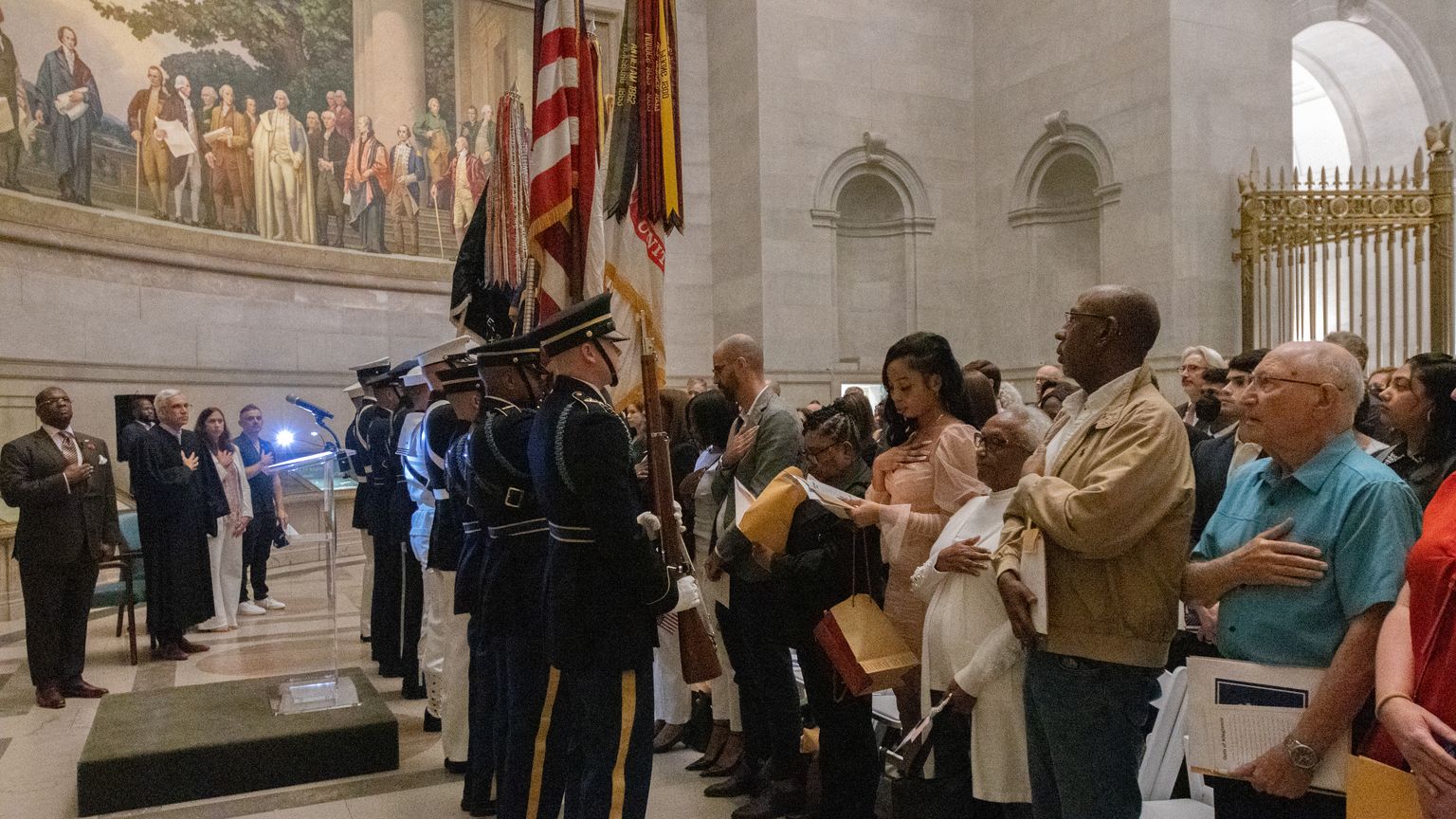
The photo above is from Constitution Day 2024 at the National Archives in Washington, D.C., where new citizens took the oath a few steps from the original Constitution.
First, the two basics
These two come before any number. All answers are from the official USCIS list of 128 questions.
- Q5 How are changes made to the U.S. Constitution? Amendments (or “the amendment process”).
- Q7 How many amendments does the U.S. Constitution have? Twenty-seven (27).
The first ten amendments are the Bill of Rights. Q6 asks what it protects: the basic rights of Americans (or “of people living in the United States”). Our post on what the Bill of Rights protects goes through those ten.
The eight amendment numbers, in order
| Amendment | Year | What it does, in a few words | Where it’s on the test |
|---|---|---|---|
| 10th | 1791 | Powers not given to the federal government belong to the states or the people | Q60 |
| 14th | 1868 | People born or naturalized here are citizens | Q97, Q68 |
| 15th | 1870 | A male citizen of any race can vote | Q98, Q63 |
| 16th | 1913 | Congress can collect an income tax | Q71 |
| 19th | 1920 | Women can vote | Q102, Q63 |
| 22nd | 1951 | A president can serve only two terms | Q37 |
| 24th | 1964 | No poll tax to vote | Q63 |
| 26th | 1971 | Citizens 18 and older can vote | Q63 |
Years are the years each amendment was ratified. You don’t need them for the test except 1870 and 1920, which are accepted answers for Q98 and Q102.
Each question, with a safe answer
10th Amendment — Q60. What is the purpose of the 10th Amendment? Say: “Powers not given to the federal government belong to the states or to the people.” This is the only accepted answer, so learn it as one sentence. It pairs with Q59, powers only for the states (schools, police, fire departments, driver’s licenses, zoning). See federal and state powers for that pair.
14th Amendment — Q97 and Q68. Q97 reads the citizenship sentence out loud: What amendment says all persons born or naturalized in the United States, and subject to the jurisdiction thereof, are U.S. citizens? Say: “The 14th Amendment.” The long question is the hint: born or naturalized means citizenship, and citizenship means 14. Q68 (How can people become United States citizens?) also mentions it: “Be born in the United States, under the conditions set by the 14th Amendment.” For an interview, “Naturalize” is the shortest correct answer to Q68.
15th and 19th Amendments — Q98 and Q102. When did all men get the right to vote? Accepted: “After the Civil War,” “During Reconstruction,” “(With the) 15th Amendment,” or “1870.” When did all women get the right to vote? Accepted: “1920,” “After World War I,” or “(With the) 19th Amendment.”
16th Amendment — Q71. Why is it important to pay federal taxes? “Required by the (U.S.) Constitution (16th Amendment)” is one accepted answer, but “Required by law” is shorter. More in taxes and your citizenship.
22nd Amendment — Q37. The President of the United States can serve only two terms. Why? Say: “Because of the 22nd Amendment” or “To keep the president from becoming too powerful.”
15th, 19th, 24th, 26th — Q63. There are four amendments to the U.S. Constitution about who can vote. Describe one of them. Note: the question asks you to describe one, not to name its number. Accepted descriptions:
- “Citizens eighteen (18) and older (can vote).” (26th)
- “You don’t have to pay (a poll tax) to vote.” (24th)
- “Any citizen can vote. (Women and men can vote.)” (19th)
- “A male citizen of any race (can vote).” (15th)
“Citizens 18 and older can vote” is the easiest one to say. Our voting amendments post has the history behind all four.
A simple way to keep the numbers straight
Group them by topic instead of memorizing eight separate numbers:
- States: 10. Ten is also how many amendments are in the Bill of Rights, and the 10th is the last of them.
- Citizens: 14. “Born or naturalized” → 14.
- Voting: 15, 19, 24, 26. Men of every race (15), then women (19), then no poll tax (24), then age 18 (26). Each one let more people vote.
- Money: 16. Income tax.
- President: 22. Two terms. Both twos: 22nd, 2 terms.
Then say each pair out loud: “Fourteen, citizens. Twenty-two, two terms.” Speaking the answer, not just reading it, is what helps on interview day. Here’s why: practice civics out loud.
Common mix-ups
- 13 vs. 27. There were 13 original states (Q121, the 13 stripes) but 27 amendments. If you hear “how many amendments,” the answer is 27.
- 10 vs. 10th. “The first ten amendments” are the Bill of Rights. “The 10th Amendment” is about state powers. Different questions.
- Q63 vs. Q98/Q102. Q63 wants a description (“Citizens 18 and older can vote”). Q98 and Q102 want a time (“1870,” “1920,” or the amendment).
- 19th vs. 1920. Both are accepted for Q102, so if one slips, use the other.
For more look-alike answers, see easily confused civics answers, and for every number on the test, the numbers to memorize.
Practice the amendment questions now
- Take a free 20-question practice test. It uses the same 128-question bank.
- Listen to all 128 questions and switch to Quiz me mode to answer out loud.
- Browse the American Government section for Q1–Q15.
Sources
- USCIS: 2025 Civics Test, 128 Questions and Answers (PDF), Q5–Q7, Q37, Q59–Q60, Q63, Q68, Q71, Q97–Q98, Q102
- USCIS Policy Manual: Volume 12, Part E, Chapter 2, English and Civics Testing (the 2025 test: 20 questions, 12 correct to pass)
- National Archives: The Constitution: Amendments 11–27 and The Bill of Rights (texts and ratification dates)
This post is a study aid. Always check the USCIS test updates page before your interview.
Photo: U.S. National Archives, via Wikimedia Commons (public domain).