What Does the Constitution Do? Civics Q3 and the 7 Articles in Plain English
“Name one thing the U.S. Constitution does.” (Q3) sounds like a big question. You could talk about the Constitution for an hour. At the interview you need one short phrase, and USCIS gives you four to choose from.
This post shows where each of those four answers comes from inside the Constitution itself. Once you see how the document is built (a Preamble, seven articles and 27 amendments), Q3 and several other questions become easy to remember.
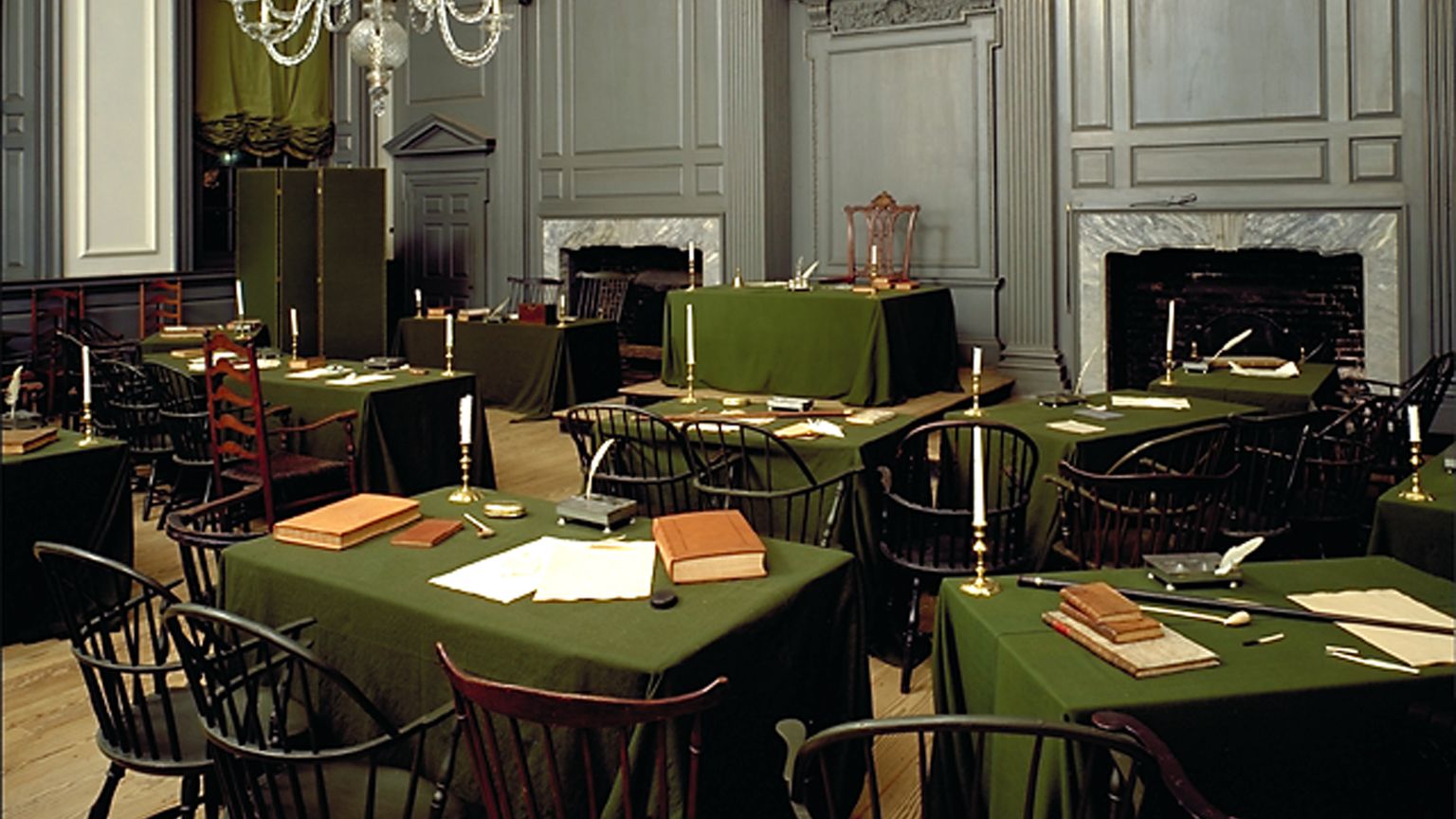
The room in the photo is the Assembly Room of Independence Hall in Philadelphia. The Constitution was written here during the summer of 1787 and signed here on September 17, 1787 (National Park Service).
The answers USCIS accepts
The USCIS list of 128 questions (PDF) gives four answers for Q3. Say one:
- “Forms the government”
- “Defines the parts of government”
- “Defines powers of government”
- “Protects the rights of the people”
The easiest pick for most people is “It forms the government.” Three words, and it is hard to get wrong.
How the Constitution is built
The original Constitution has three parts, and the amendments were added later:
| Part | What it does | Q3 answer it matches |
|---|---|---|
| Preamble (“We the People…”) | Says who is making the government and why | Forms the government |
| Article I | Congress (the legislative branch) and its powers | Defines the parts / powers of government |
| Article II | The President (the executive branch) and his or her powers | Defines the parts / powers of government |
| Article III | The Supreme Court and federal courts (the judicial branch) | Defines the parts / powers of government |
| Article IV | How the states relate to each other; adding new states | Defines powers of government |
| Article V | How to amend (change) the Constitution | (Q5) |
| Article VI | The Constitution is “the supreme Law of the Land” | (Q2) |
| Article VII | Ratification: approval by 9 of the 13 states | Forms the government |
| 27 amendments (first 10 = Bill of Rights) | Changes and additions, including our basic rights | Protects the rights of the people |
You can read the full text in the National Archives transcription of the Constitution. Now let’s walk through the four answers.
Answer 1: It forms the government
The Preamble is one sentence. It ends with the words “do ordain and establish this Constitution for the United States of America.” In plain English: we are creating this government. That is what “forms the government” means.
The Preamble begins with “We the People”. That is the next question on the test, Q4. The answer is the idea that the people create the government and give it its power: self-government, popular sovereignty, or consent of the governed. Q3 and Q4 are a natural pair: the Constitution forms the government, and the power to do that comes from the people.
The last article, Article VII, explains how the new government would start: once nine states ratified (approved) the Constitution, it would take effect. New Hampshire became the ninth state in June 1788, and the new government began working in 1789.
Answer 2: It defines the parts of government
The first three articles create the three branches of government (Q16):
- Article I: the legislative branch, Congress (the Senate and the House of Representatives).
- Article II: the executive branch, led by the President.
- Article III: the judicial branch, the Supreme Court and the other federal courts.
A simple trick: 1-2-3 = Congress, President, Courts. It is the same order USCIS uses in the Q16 answer “Congress, president, and the courts.” Why three branches? So one part does not become too powerful (Q15, explained in our checks and balances post).
Answer 3: It defines powers of government
The Constitution does not only name the branches. It says what each branch is allowed to do:
- Congress (Article I, Section 8) has a list of powers, such as collecting taxes, coining money and declaring war. Several of these are answers to Q20 (“Name one power of the U.S. Congress”).
- The President (Article II) is Commander in Chief of the military, makes treaties with the Senate’s approval, appoints federal judges, and must “take Care that the Laws be faithfully executed.” These match Q41 and Q42.
- The courts (Article III) decide cases about the law. Federal judges keep their jobs “during good Behaviour,” which is why Supreme Court justices serve for life (Q55).
The Constitution also limits power. The 10th Amendment says powers not given to the federal government belong to the states or to the people (Q60, see Federal vs. State Powers). And Article VI makes the Constitution “the supreme Law of the Land”, which is the answer to Q2: no law or government official is above it.
Answer 4: It protects the rights of the people
The first ten amendments, the Bill of Rights, were added in 1791. They protect basic rights such as freedom of speech, religion and the press, and the right to a fair trial. That is Q6: the Bill of Rights protects “(the basic) rights of Americans” or “(the basic) rights of people living in the United States.”
Today the Constitution has 27 amendments (Q7), and amendments are how it changes (Q5). Article V explains that process. See How the Constitution Changes and What the Bill of Rights Protects.
Questions that connect to Q3
Study these together. They are easier as a group:
| Question | Answer |
|---|---|
| Q2 What is the supreme law of the land? | The (U.S.) Constitution |
| Q4 What does “We the People” mean? | Self-government; consent of the governed |
| Q5 How are changes made to the Constitution? | Amendments |
| Q6 What does the Bill of Rights protect? | (The basic) rights of Americans |
| Q7 How many amendments does the Constitution have? | Twenty-seven (27) |
| Q16 Name the three branches of government. | Legislative, executive, and judicial |
| Q82 What founding document was written in 1787? | The (U.S.) Constitution |
| Q88 James Madison is famous for many things. Name one. | “Father of the Constitution” |
How to say it at the interview
The officer asks: “Name one thing the U.S. Constitution does.” You can answer:
“It forms the government.”
That’s enough. If you want a backup, “It protects the rights of the people” is also short and easy to say. Do not answer with a single word like “laws” or “rights” alone; say the full short phrase. If you didn’t hear the question clearly, it is fine to ask the officer to repeat it (what to say).
Quick self-check
- Give two of the four USCIS answers to Q3.
- Which article creates Congress? The President? The courts?
- Which part of the Constitution starts with “We the People”?
- Which article calls the Constitution “the supreme Law of the Land”?
- In what year were the first ten amendments added?
- Any two of: forms the government, defines the parts of government, defines powers of government, protects the rights of the people.
- Article I = Congress, Article II = the President, Article III = the courts (1-2-3 = Congress, President, Courts).
- The Preamble.
- Article VI.
- 1791 (the Bill of Rights).
Practice Q3 with the rest of the Principles of American Government questions in the practice test, or listen to them on the go with Listen.
Read next
- Principles of American Government on the 2025 Civics Test
- The Three Branches of Government on the 2025 Civics Test
- Constitution Day: Why September 17 Matters on the Civics Test
- Documents That Influenced the U.S. Constitution (Q14)
- Federalist Papers and Benjamin Franklin on the 2025 Civics Test
Sources: USCIS, 2025 Civics Test, 128 Questions and Answers (PDF) (Q2–Q7, Q15, Q16, Q20, Q41, Q42, Q55, Q60, Q82, Q88); USCIS, 2025 Civics Test; National Archives, The Constitution of the United States: A Transcription (Preamble, Articles I–VII) and The Bill of Rights: A Transcription; National Park Service, Independence Hall. Photo: National Park Service, Independence National Historical Park, via Wikimedia Commons (public domain).
This post is general study information, not legal advice. CitizenExams is an independent study site and is not affiliated with USCIS.