The 14th Amendment on the Civics Test: Born or Naturalized in the United States (Q97)
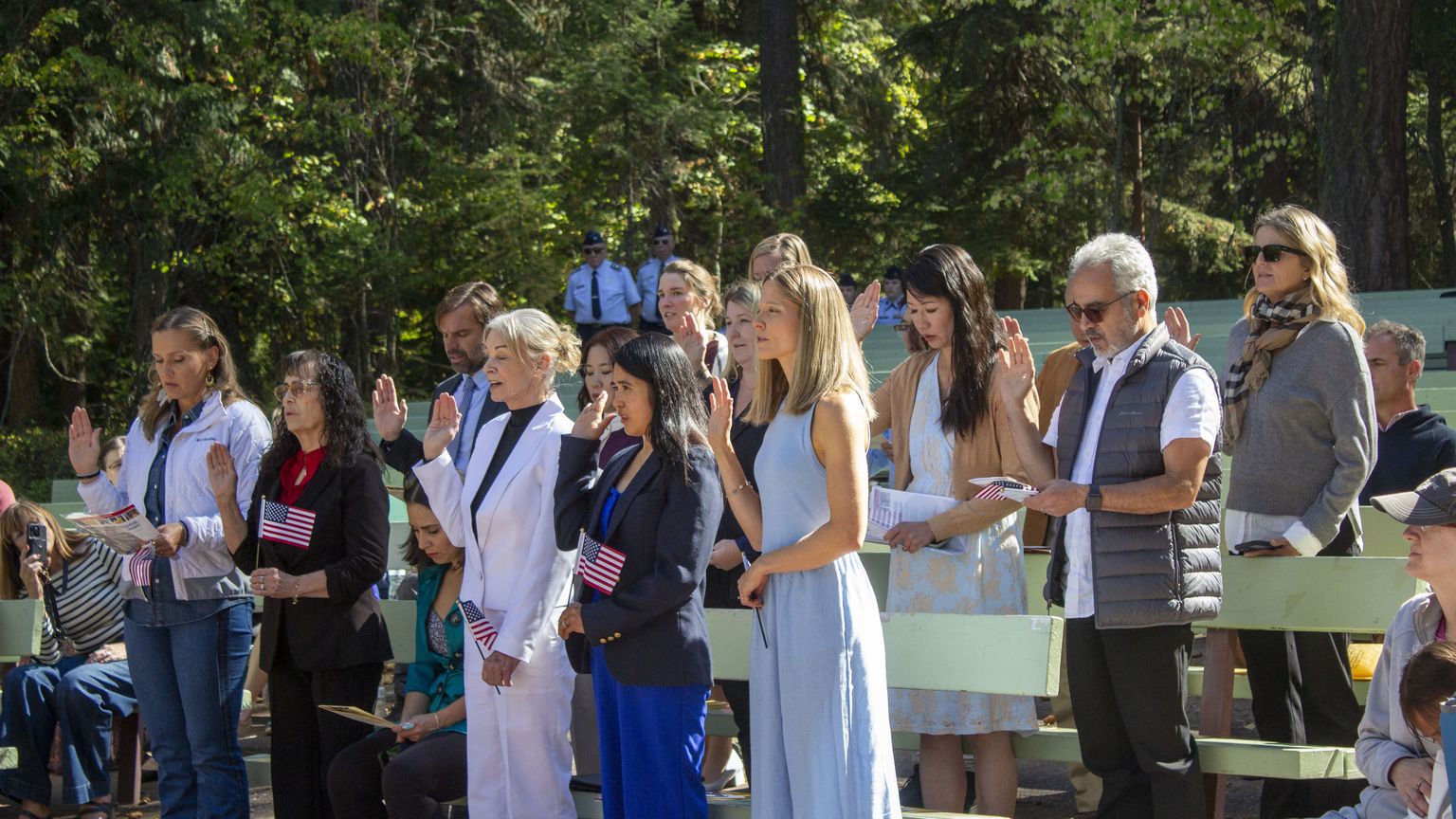
Every person who passes the naturalization interview and takes the Oath of Allegiance becomes a citizen under one sentence of the Constitution. That sentence is in the 14th Amendment, and the 2025 civics test asks about it directly in Question 97. The answer is short, but the wording of the question is long, so it helps to know exactly what the amendment says and how it fits with the other Civil War–era amendments.
The photo shows new citizens raising their right hands during a naturalization ceremony at Glacier National Park in Montana in September 2025.
The test answer
| Question | Accepted answer (2025 test) |
|---|---|
| Q97. What amendment says all persons born or naturalized in the United States, and subject to the jurisdiction thereof, are U.S. citizens? | 14th Amendment |
Q97 is in the American History section, under 1800s. You can practice it with its neighbors in American History: 1800s or open the single Question 97 page.
Listening tip: the officer will read the full question aloud. Listen for the words “born or naturalized” and “citizens.” When you hear them together, the answer is the 14th Amendment.
What the 14th Amendment says
The 14th Amendment was ratified in 1868, three years after the Civil War ended. Its first sentence, Section 1, is called the Citizenship Clause:
“All persons born or naturalized in the United States, and subject to the jurisdiction thereof, are citizens of the United States and of the State wherein they reside.”
In plain English, the clause names two ways to be a U.S. citizen:
- Born in the United States (and subject to its jurisdiction), or
- Naturalized in the United States.
It also says a citizen is a citizen of two governments at once: the United States and the state where the person lives.
Section 1 goes on to protect citizens’ “privileges or immunities,” and it says no state may deny any person due process of law or the equal protection of the laws. Those parts are not test answers, but they explain why the 14th Amendment is one of the most cited parts of the Constitution.
Why Q97 matters to naturalization applicants
The word naturalized in the clause is about people going through the process you are in now. Once you take the oath, the Constitution puts you in the same sentence as people born here: “citizens of the United States and of the State wherein they reside.”
The same idea shows up in another test question. Q68 asks how people become U.S. citizens, and the official answers are:
- Be born in the United States, under the conditions set by the 14th Amendment
- Naturalize
- Derive citizenship (under conditions set by Congress)
So if you learn Q97, you already know the first answer to Q68. For more on Q68, see How People Become Citizens and Civic Participation (Q68–Q72). The third answer, deriving citizenship, is how many children become citizens when a parent naturalizes; see Do Your Children Become Citizens When You Naturalize?
13th, 14th, 15th: the three Reconstruction amendments
After the Civil War, three amendments were added within five years. They are easy to mix up because the numbers are in a row. One key word for each helps:
| Amendment | Ratified | Key word | What it did | Related test questions |
|---|---|---|---|---|
| 13th | 1865 | Freedom | Ended slavery in the United States | Q95 (Emancipation Proclamation), Q96 (war that ended slavery: the Civil War) |
| 14th | 1868 | Citizenship | People born or naturalized in the U.S. are citizens; due process and equal protection | Q97, Q68 |
| 15th | 1870 | Voting | The right to vote cannot be denied because of race, color or previous condition of servitude | Q98, Q63 |
Memory trick: free, citizen, vote, in that order. First people were freed (13th), then their citizenship was written into the Constitution (14th), then their right to vote was protected (15th).
The Civil War questions around Q97 are covered in Civil War, Abraham Lincoln, and the Emancipation Proclamation. For a list of every amendment that appears on the test, see Every Amendment on the 2025 Civics Test, by Number.
Related question: Q98
Right after Q97, the test asks about voting.
| Question | Accepted answers (2025 test) |
|---|---|
| Q98. When did all men get the right to vote? | After the Civil War; During Reconstruction; (With the) 15th Amendment; 1870 |
Any one of these answers is enough. Note the word men in the question: the 15th Amendment protected voting regardless of race, but women did not get the right to vote nationwide until the 19th Amendment in 1920 (Q102). The full voting story is in Voting Amendments on the 2025 Civics Test.
Common mix-ups
- Saying “the 13th” for Q97. The 13th ended slavery. Citizenship for people born or naturalized here is the 14th.
- Saying “the 15th” for Q97. The 15th is about voting. Q97 is about citizenship.
- Saying “the Bill of Rights.” The Bill of Rights is the first ten amendments (1791). The 14th came much later, in 1868.
- Answering “the Constitution” or “naturalization.” Q97 asks what amendment, so say a number: the 14th Amendment.
- Mixing up 1868 and 1870 on Q98. The 14th was ratified in 1868. The 15th, the voting amendment, is 1870, and 1870 is the accepted year for Q98.
Quick drill (say it out loud)
- What amendment says all persons born or naturalized in the United States are citizens? The 14th Amendment.
- When did all men get the right to vote? After the Civil War (or with the 15th Amendment, or 1870).
- What U.S. war ended slavery? The Civil War.
- Name one way people can become U.S. citizens. Naturalize.
- What did the Emancipation Proclamation do? Freed the slaves.
The civics test is oral, so saying answers out loud is the best practice. Try the free practice test or the hands-free Listen mode.
Read next
- How the Constitution Changes: The Amendment Process Behind Civics Q5 and Q7
- Every Amendment on the 2025 Civics Test, by Number
- Voting Amendments on the 2025 Civics Test (Q63, Q97, Q98, Q102)
- Can You Keep Your Other Citizenship After You Naturalize?
Sources: U.S. Constitution, Fourteenth Amendment (Constitution Annotated, Library of Congress); National Archives: 14th Amendment to the U.S. Constitution (1868); 13th Amendment (1865) and 15th Amendment (1870), National Archives; USCIS 2025 civics test questions. Photo: GlacierNPS (National Park Service), via Wikimedia Commons (public domain).
CitizenExams is an independent study site and is not affiliated with USCIS.