The Great Depression on the 2025 Civics Test (Q103–Q105)
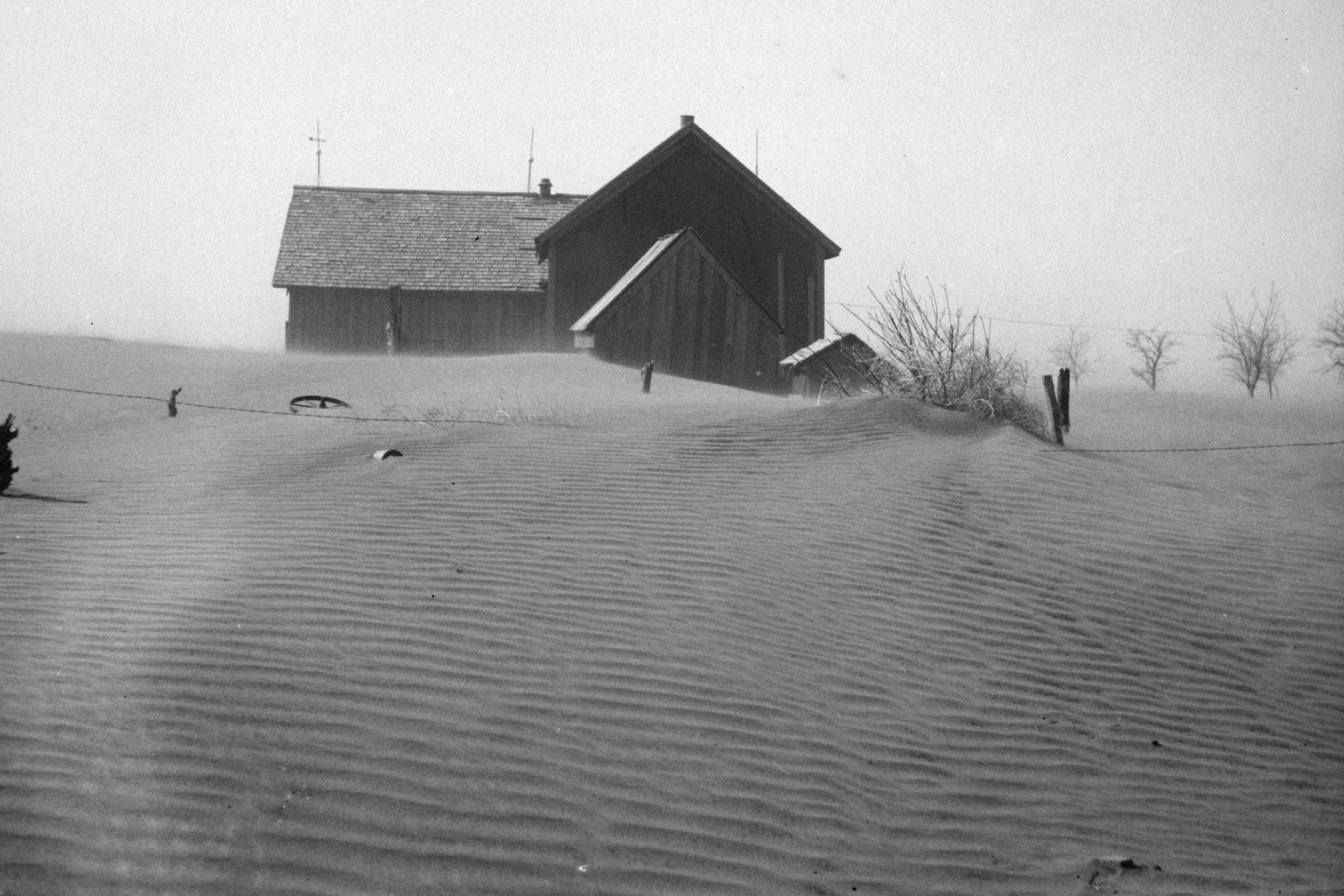
Three questions in the Recent American History block of the 2025 Naturalization Civics Test are about the same hard decade: What was the Great Depression? (Q103), When did the Great Depression start? (Q104), and Who was president during the Great Depression and World War II? (Q105). The photo above is a 1936 farm in Oklahoma half buried in dust, one of the best-known images of those years. The answers are short, so you only need a few words for each.
What was the Great Depression? (Q103)
Accepted answer, from the official USCIS list:
- Longest economic recession in modern history
Say it as one sentence: “It was the longest economic recession in modern history.” An officer is listening for the idea of a very long, very deep economic downturn, so you do not need dates or statistics here.
When did the Great Depression start? (Q104)
Accepted answers:
- The Great Crash (1929)
- Stock market crash of 1929
Either one works. The easiest way to remember it is 1929: the stock market crashed in October 1929, and the economy kept falling for years afterward.
Who was president during the Great Depression and World War II? (Q105)
Accepted answer:
- (Franklin) Roosevelt
“Roosevelt” alone is enough. Franklin D. Roosevelt was elected in 1932, took office in March 1933, and was elected four times. He was president until he died in April 1945, so he led the country through the worst of the Depression and most of World War II. Do not mix him up with Theodore Roosevelt, who was president much earlier, from 1901 to 1909.
A short story to remember it
These facts are study context only. On the test, just give the short answers above.
- The crash. In October 1929, stock prices fell sharply. Many banks failed, businesses closed, and millions of people lost jobs and savings. At the worst point, in 1933, roughly one in four workers had no job.
- The Dust Bowl. In the 1930s a long drought hit the Great Plains, and strong winds blew away dry topsoil in huge dust storms. Many farm families left their land, which is what the hero photo shows.
- The New Deal. Roosevelt’s programs, called the New Deal, put people to work and set up protections that still exist, including Social Security (1935).
- How it ended. The economy recovered during the late 1930s and 1940s, as the United States prepared for and then fought in World War II.
Memory trick: Crash in 1929, Roosevelt in charge. If you remember those four words, you have Q103–Q105.
Connect it: the next question is World War II
The same president leads straight into the next question. Why did the United States enter World War II? (Q106). Accepted answers include (Bombing of) Pearl Harbor, Japanese attacked Pearl Harbor, to support the Allied Powers (England, France, and Russia), and to oppose the Axis Powers (Germany, Italy, and Japan). Q104–Q107 are covered together in World War II, Eisenhower, and the Great Depression.
For the earlier women’s suffrage question right before this block (Q102), see Susan B. Anthony and women’s suffrage.
One-minute review
| Question | Say this |
|---|---|
| Q103 — What was the Great Depression? | Longest economic recession in modern history |
| Q104 — When did the Great Depression start? | Stock market crash of 1929 (or the Great Crash, 1929) |
| Q105 — Who was president during the Great Depression and World War II? | (Franklin) Roosevelt |
Study these related questions
- Recent American History: Q103–Q116 in context, with audio
- World War II, Eisenhower, and the Great Depression: Q104–Q107 together
- Which civics test: 2008 vs 2025: check which question set applies to you
- Free scored practice test: 20 questions like the interview, 12 correct to pass
This is an evergreen study post. The answers come from the official USCIS 128 Civics Questions and Answers (2025 version), used for Form N-400 filed on or after October 20, 2025 (USCIS Policy Manual, Vol. 12, Part E, Ch. 2). Background details are from Federal Reserve History: The Great Depression, the National Archives: Social Security Act (1935), and the Miller Center: Franklin D. Roosevelt. Photo: Library of Congress.
This post summarizes public USCIS civics materials for educational study. It is not legal advice.