Veterans Day and Citizenship: The Military Civics Questions and How Service Members Naturalize
Veterans Day is Wednesday, November 11. It’s a good week to lock in the civics questions about the military. They’re short, and two of them sound so alike that people mix them up. If you serve or served in the U.S. armed forces yourself, there’s a second part below: the special path to citizenship for service members.
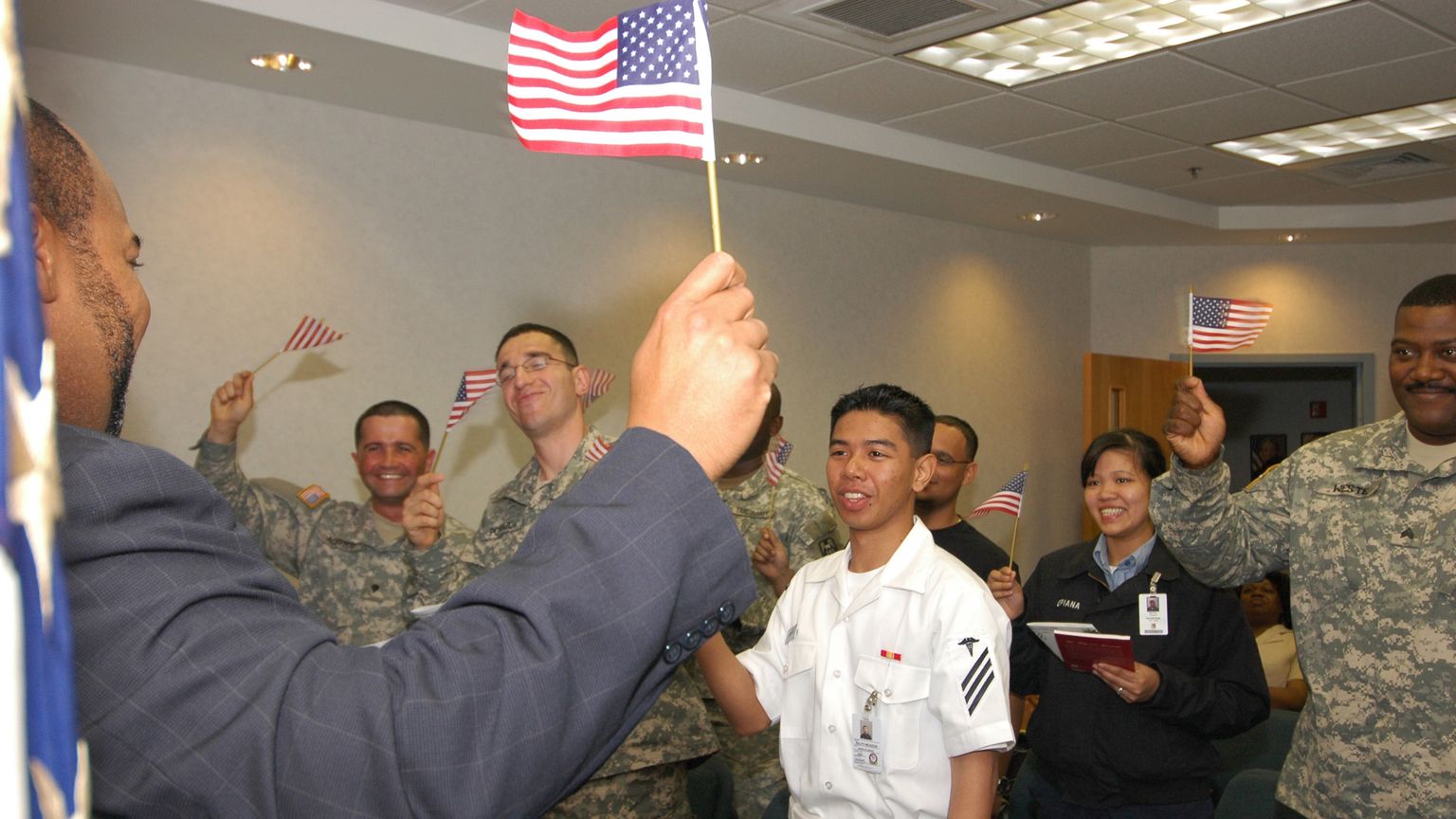
The photo above is from a 2007 naturalization ceremony in Norfolk, Virginia, where nine sailors and soldiers from seven countries took the Oath of Allegiance.
Part 1: the military questions on the 2025 civics test
All answers below come from the official USCIS list of 128 questions.
| Question | A safe answer to say |
|---|---|
| Q127 What is Memorial Day? | A holiday to honor soldiers who died in military service |
| Q128 What is Veterans Day? | A holiday to honor people who have served in the U.S. military |
| Q42 Who is Commander in Chief of the U.S. military? | The President |
| Q70 One way Americans can serve their country | Serve in the military (or: vote, pay taxes, obey the law) |
| Q67 Two promises in the Oath of Allegiance | Serve in the military (if needed), obey the laws of the United States |
| Q72 Why register for the Selective Service? | Required by law |
| Q126 Name three national holidays | Memorial Day, Veterans Day, Independence Day |
Memorial Day vs. Veterans Day: don’t swap them
This is one of the most common mix-ups on the test. A simple way to keep them apart:
- Memorial Day (last Monday in May) remembers those who died in military service. Memorial sounds like memory.
- Veterans Day (November 11) thanks everyone who served, living or not. A veteran is someone who served.
If you’re asked about Veterans Day, USCIS accepts “A holiday to honor people in the (U.S.) military” or “A holiday to honor people who have served (in the U.S. military).” Just don’t say “soldiers who died.” That’s Memorial Day. More holiday answers are in national holidays on the civics test, and more look-alike answers are in commonly confused civics answers.
Tip for Q126: Memorial Day and Veterans Day are both on the accepted list of national holidays, so once you know them you already have two of the three you need.
The Oath promise and the Selective Service question
Q67 asks for two promises new citizens make. “Serve in the military (if needed)” is accepted. Our post on the Oath of Allegiance promises explains the rest, and some people can ask to modify that part of the oath.
Q72 says all men age 18 through 25 should register for the Selective Service and asks why. Say “Required by law.” The N-400 also asks male applicants about Selective Service registration. See Selective Service and your N-400.
Part 2: if you serve or served, there’s a special path to citizenship
USCIS has special naturalization rules for military members under two sections of the Immigration and Nationality Act (INA). You still file Form N-400, but there is no USCIS fee when you apply under INA 328 or 329.
INA 328: one year of honorable service, at any time. You may qualify if you:
- are 18 or older,
- served honorably in the U.S. armed forces for a total of at least 1 year, and if you’ve separated, you left under honorable conditions,
- are a lawful permanent resident at the time of your interview, and
- meet the other requirements USCIS lists, including certain residence and physical presence rules, English and civics (unless an exception applies), and good moral character for 5 years before filing.
INA 329: service during a designated period of hostilities. USCIS lists these periods:
- April 6, 1917 – November 11, 1918
- September 1, 1939 – December 31, 1946
- June 25, 1950 – July 1, 1955
- February 28, 1961 – October 15, 1978
- August 2, 1990 – April 11, 1991
- September 11, 2001 – present
Under INA 329, you must have served honorably during one of those periods. You don’t need a green card if you were physically present in the U.S. (or in certain listed places) when you enlisted, reenlisted, extended, or were inducted. You’re exempt from the continuous residence and physical presence requirements, and good moral character is required for 1 year before filing. You still take the English and civics test unless an exception applies.
The paperwork
- Still serving? Have your chain of command certify Form N-426, Request for Certification of Military or Naval Service, and file it with your N-400.
- Already separated? Send a copy of your DD Form 214, NGB Form 22, or other official discharge document for all periods of service.
- You can file online with a USCIS account or by mail. Many installations have a USCIS liaison, and USCIS runs a Military Help Line at 877-CIS-4MIL (877-247-4645), Monday–Friday, 8 a.m.–8 p.m. Eastern.
- Former service members must do the interview and the oath in the United States. If you live abroad, USCIS explains how to request parole with Form I-131 filed together with your N-400.
USCIS also offers posthumous citizenship (Form N-644) for service members who died from service during a period of hostilities. It must be filed within two years of the service member’s death.
Study the same way as everyone else
The civics test is the same 2025 test for service members, so the 20-question practice test and audio for all 128 questions work just as well during deployments, drills, or a long drive. Not sure which test applies to you? Check 2008 vs. 2025: which civics test am I taking?
To every veteran and service member studying for this: thank you for your service.
Sources
- USCIS: Naturalization Through Military Service (INA 328 and 329, periods of hostilities, N-426, no fee, Military Help Line, posthumous citizenship)
- USCIS Policy Manual: Volume 12, Part I, Military Members and Their Families
- USCIS: Form N-426
- USCIS: 2025 Civics Test, 128 Questions and Answers (PDF), Q42, Q67, Q70, Q72, Q126–Q128
This post summarizes public USCIS materials for educational purposes. It is not legal advice. Always follow the instructions on your own USCIS notices.
Photo: U.S. Navy photo by Mass Communication Specialist 2nd Class Flordeliz Valerio, via Wikimedia Commons (public domain).