Mock Civics Interview: 20 Questions From the 2025 Test (Answer Key Below)
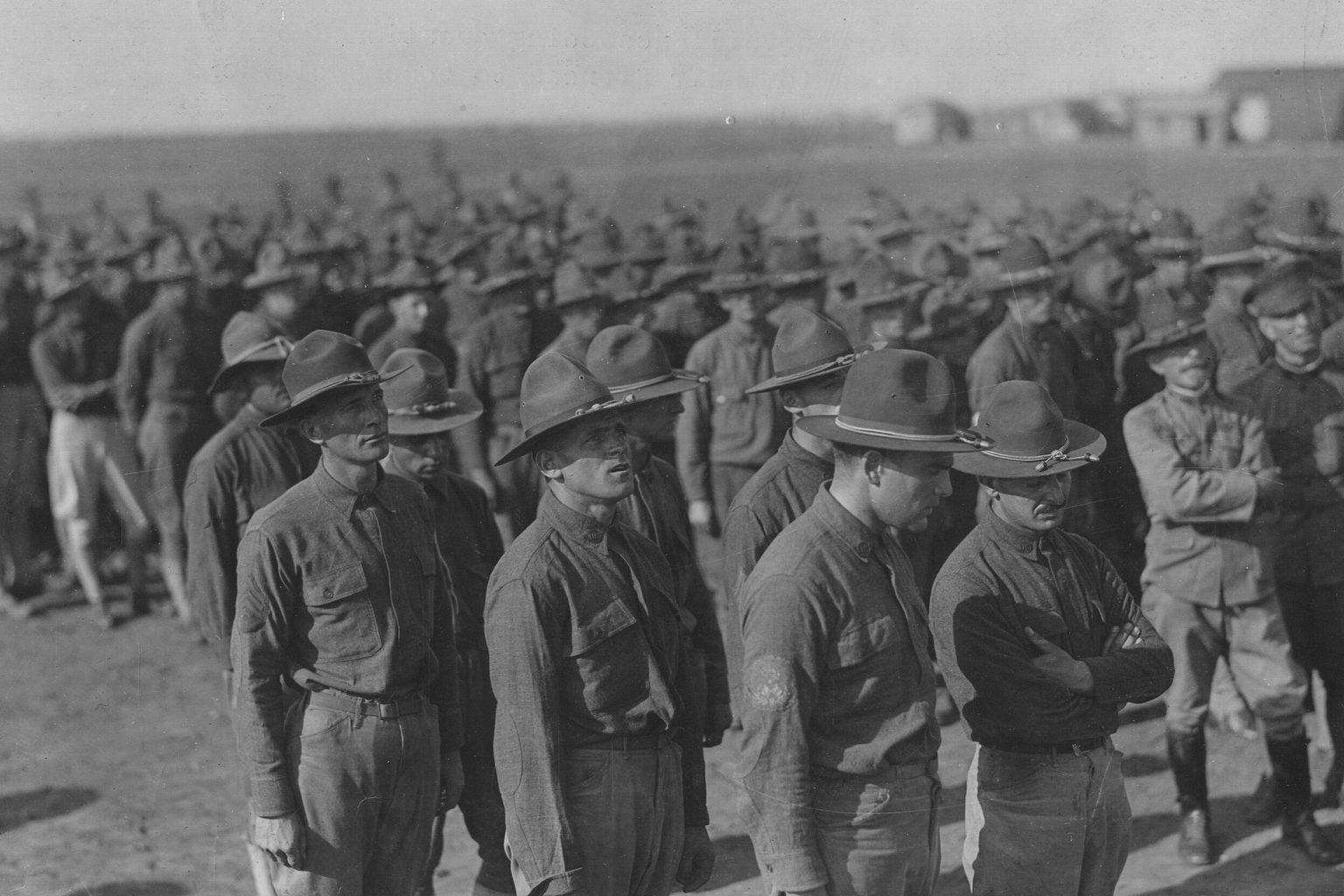
Reading answers is not the same as being asked. On interview day a USCIS officer reads a question out loud and waits, and you have to pull the answer from memory with no list in front of you. The men in the photo above, lined up on June 13, 1918 to be questioned by a naturalization examiner, faced the same moment.
This post is a mock civics interview you can run at home in about five minutes. It uses 20 questions from the official 2025 civics test (128 questions), mixed across government, history, and symbols, and it is scored the way the real test is.
How the real 2025 civics test works
- The officer asks you up to 20 questions from the 128-question list.
- You need 12 correct to pass.
- The officer can stop early: as soon as you reach 12 correct, or once you have 9 incorrect.
- The test is oral. You answer out loud, in English (unless you qualify for an exception).
The 2025 test applies if you filed Form N-400 on or after October 20, 2025. If you filed earlier, you take the 2008 test instead; see Which Civics Test Am I Taking?. If you qualify for 65/20, you study only the 20 starred questions; see Age 65/20, 50/20, and 55/15.
How to run this mock
- Ask a friend or family member to read the questions to you, or read each one aloud yourself and look away from the screen before you answer.
- Answer out loud, in a short phrase. You don’t need a full sentence.
- Don’t scroll to the answer key until you finish all 20.
- Keep a tally: correct and incorrect. Stop at 12 correct (you passed) or 9 incorrect (you would not pass this round).
The 20 questions
- What is the supreme law of the land?
- What war did the Americans fight to win independence from Britain?
- What are the two parts of the U.S. Congress?
- What is the name of the national anthem?
- The President of the United States is elected for how many years?
- There are three branches of government. Why?
- What founding document was written in 1787?
- How many seats are on the Supreme Court?
- Who was president during the Great Depression and World War II?
- Who can vote in federal elections, run for federal office, and serve on a jury in the United States?
- Why does the flag have 50 stars?
- Why do U.S. representatives serve shorter terms than U.S. senators?
- Name the U.S. war between the North and the South.
- What does the President’s Cabinet do?
- Who was the United States’ main rival during the Cold War?
- Why is it important to pay federal taxes?
- Name one power that is only for the states.
- The Nation’s first motto was “E Pluribus Unum.” What does that mean?
- What major event happened on September 11, 2001 in the United States?
- What is the economic system of the United States?
Done? Count your score before you look.
Answer key
Each answer below is one accepted answer from the official USCIS list (the question number is in parentheses). Any other answer on the official list for that question is also correct.
| # | Question (USCIS number) | One accepted answer |
|---|---|---|
| 1 | Supreme law of the land (Q2) | The Constitution |
| 2 | War for independence (Q76) | The American Revolution (Revolutionary War, War for Independence) |
| 3 | Two parts of Congress (Q19) | The Senate and the House (of Representatives) |
| 4 | National anthem (Q123) | The Star-Spangled Banner |
| 5 | President’s term (Q36) | Four (4) years |
| 6 | Why three branches (Q15) | So one part does not become too powerful (checks and balances, separation of powers) |
| 7 | Document written in 1787 (Q82) | The (U.S.) Constitution |
| 8 | Supreme Court seats (Q53) | Nine (9) |
| 9 | President in the Depression and WWII (Q105) | (Franklin) Roosevelt |
| 10 | Vote, run for federal office, serve on a jury (Q64) | U.S. citizens |
| 11 | Why 50 stars (Q122) | One star for each state (50 states) |
| 12 | Why representatives serve shorter terms (Q26) | To more closely follow public opinion |
| 13 | War between the North and South (Q92) | The Civil War |
| 14 | What the Cabinet does (Q47) | Advises the President |
| 15 | Main rival in the Cold War (Q108) | The Soviet Union (USSR, Russia) |
| 16 | Why pay federal taxes (Q71) | Required by law (all people pay to fund the federal government, required by the 16th Amendment, civic duty) |
| 17 | Power only for the states (Q59) | Provide schooling and education (also police, fire departments, driver’s licenses, zoning and land use) |
| 18 | “E Pluribus Unum” (Q124) | Out of many, one (we all become one) |
| 19 | September 11, 2001 (Q115) | Terrorists attacked the United States |
| 20 | Economic system (Q12) | Capitalism (free market economy) |
What your score means
- 12 or more correct before 9 wrong: you would have passed this round. Try another random set to make sure it wasn’t a lucky draw.
- Close, but 9 wrong came first: look at which questions you missed. If they bunch up in one area (for example, the “why” questions or the Cold War), study that topic first instead of rereading all 128.
- Several blanks: that’s normal early on. A blank often means you recognize the answer when you see it but haven’t said it out loud enough to recall it on the spot.
Questions 6, 12, 16, and 17 ask why, or ask you to name one item from a longer list. If those slowed you down, see The 19 “Why” Questions on the 2025 Civics Test and Federal vs. State Powers.
Run a fresh set every day
One mock tells you where you are today. A fresh set every day or two tells you whether it’s sticking. The free practice test gives you a new random 20 from all 128 each time and scores it the same way (12 correct to pass). Any question you miss goes into your review deck on this device, so the next session starts with your weak spots. If you’d rather listen, Listen mode reads questions and answers aloud.
Study these next
- Practice Out Loud for the Naturalization Civics Interview
- Easily Confused Answers on the 2025 Civics Test
- 42 Civics Test Questions With One- or Two-Word Answers
- A 10–15 Minute Daily Schedule for the 2025 Civics Test
- Naturalization Interview Day: What to Expect
This is an evergreen study post. Questions and answers come from the official USCIS 128 Civics Questions and Answers (2025 version), used for Form N-400 filed on or after October 20, 2025 (2025 Civics Test). Check Check for Test Updates before your interview. Photo: U.S. National Archives.
This post summarizes public USCIS civics materials for educational study. It is not legal advice.