How a Bill Becomes a Law: Signing, Vetoes and Judges on Civics Q41 and Q43–Q46
Five questions on the 2025 civics test are really one story: how a bill becomes a law, and what the President does along the way. Q43 asks who signs bills, Q44 asks who vetoes them, Q45 asks who appoints federal judges, Q41 asks for one power of the president, and Q46 asks for one part of the executive branch.
The answers are short. Q43, Q44 and Q45 are all “the President.” But the story behind them is what makes them stick, and it also explains Q15 (checks and balances), Q18 and Q20 (what Congress does).
The answers USCIS accepts
| Question | Accepted answers (from USCIS) |
|---|---|
| Q41. Name one power of the president. | Signs bills into law · Vetoes bills · Enforces laws · Commander in Chief (of the military) · Chief diplomat · Appoints federal judges |
| Q43. Who signs bills to become laws? | The President (of the United States) |
| Q44. Who vetoes bills? | The President (of the United States) |
| Q45. Who appoints federal judges? | The President (of the United States) |
| Q46. The executive branch has many parts. Name one. | President (of the United States) · Cabinet · Federal departments and agencies |
Safe answers: “Signs bills into law” for Q41, “the President” for Q43–Q45, and “the Cabinet” for Q46.
Step by step: from bill to law
The rules are in Article I, Section 7 of the Constitution.
- Congress writes the bill. Writing laws is Congress’s job (Q18, and “writes laws” is an answer to Q20). A member of the House or Senate introduces it. Bills for raising money (taxes) must start in the House.
- Both chambers pass the same text. The House and the Senate (Q19) each vote on it. If their versions differ, they work out one version and both pass it again. A bill that passes only one chamber goes nowhere.
- The bill goes to the President. Now the President has three choices.
| The President… | What happens |
|---|---|
| Signs it | It becomes law. This is Q43. |
| Vetoes it (returns it unsigned, with objections, to the chamber where it started) | It does not become law, unless Congress overrides the veto by a two-thirds vote in both the House and the Senate. This is Q44. |
| Does nothing for 10 days (Sundays not counted) while Congress is in session | It becomes law without the President’s signature. |
There’s one more case. If Congress adjourns during those 10 days, so the President can’t return the bill, and the President doesn’t sign it, the bill dies. That’s called a pocket veto, and Congress can’t override it, because there’s nothing to vote on. To pass that law, Congress must start over.
“Veto” is Latin for “I forbid.” You don’t need that on the test, but it helps the word stick.
Why a veto matters: checks and balances
The veto is the President’s check on Congress. The override is Congress’s check on the President. Neither side can make a law alone, which is the whole idea behind Q15: “There are three branches of government. Why?” → checks and balances / so one part does not become too powerful.
Overrides are hard. Two-thirds of the House is 290 of 435 members (Q24) and two-thirds of the Senate is 67 of 100 (Q21), if everyone votes. That’s why most vetoes stand. The U.S. Senate’s records count 2,599 vetoes since 1789, and Congress overrode only 112 of them. Franklin D. Roosevelt, who served the longest, used the veto the most: 635 times.
The President can’t veto part of a bill. It’s all or nothing. Congress gave Presidents a “line-item veto” in 1996, but the Supreme Court struck it down in Clinton v. City of New York (1998). It said the Constitution only allows a President to sign or return the whole bill. (That’s the judicial branch checking the other two: Q51.)
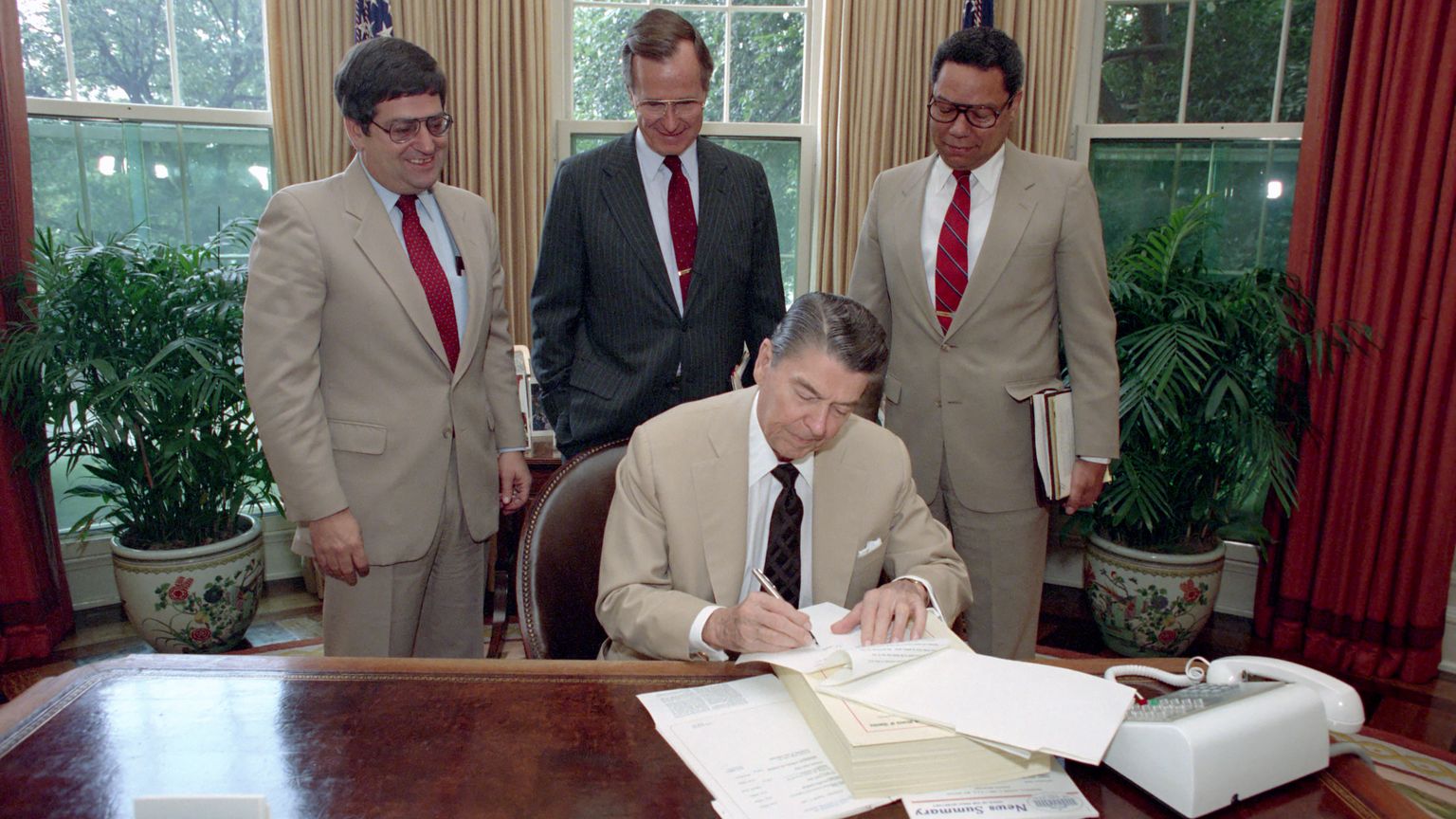
The photo above shows a real veto: President Reagan signing his veto of a defense authorization bill in the Oval Office on August 3, 1988.
Appointing federal judges (Q45)
Under Article II, Section 2, the President nominates federal judges, including Supreme Court justices, and appoints them “by and with the Advice and Consent of the Senate.” In practice:
- The President picks a nominee.
- The Senate Judiciary Committee holds a hearing and votes.
- The full Senate votes. A simple majority confirms.
- The President appoints the judge, who serves for life (Q55), so judges can stay independent of politics (Q56).
For Q45 the answer is still just “the President.” But if the officer asks a follow-up in conversation, it helps to know the Senate must agree.
The other powers in Q41
| Q41 answer | What it means |
|---|---|
| Signs bills into law | The last step for a bill (Q43) |
| Vetoes bills | Rejects a bill Congress passed (Q44) |
| Enforces laws | The executive branch carries out laws Congress passes. Congress writes, the President enforces, the courts explain. |
| Commander in Chief (of the military) | The President leads the armed forces (Q42). Only Congress can declare war (Q20). |
| Chief diplomat | The President leads foreign policy and makes treaties, which need two-thirds of the Senate to approve. |
| Appoints federal judges | With Senate consent (Q45) |
Q46: parts of the executive branch
The President doesn’t enforce laws alone. The executive branch includes the President, the Cabinet (which advises the President, Q47) and the federal departments and agencies, such as the Department of Homeland Security, the department that USCIS is part of. Any one of those three is a full answer. Two Cabinet positions is a different question: Q48.
Traps that cost points
- Saying “Congress” for Q43. Congress passes bills. The President signs them into law.
- Saying “Congress” or “the Senate” for Q45. The Senate confirms, but the question asks who appoints: the President.
- Saying “the Supreme Court” for Q44. Courts can strike down a law later (Q51), but they don’t veto bills.
- Saying “declares war” for Q41. That’s a power of Congress (Q20). The President’s matching answer is Commander in Chief.
- Saying a name. Q43–Q45 ask for the office, not the person. The name of the President now is a different question, Q38.
30-second drill (say it out loud)
- Who signs bills to become laws? → The President.
- Who vetoes bills? → The President.
- Who appoints federal judges? → The President.
- Name one power of the president. → Signs bills into law.
- The executive branch has many parts. Name one. → The Cabinet.
- Name one power of Congress. → Writes laws.
Questions 1 to 3 have the same answer. Questions 4 and 6 are the pair to keep apart: Congress writes, the President signs.
The new Congress
Yesterday’s midterm election chose the members of the next Congress, which meets in January 2027. The answers to Q41 and Q43–Q46 don’t change with an election, because they name offices and powers. Answers that name people (Q23, Q29, Q30) can change. See the November 3 midterms and your civics test.
Practice them
- Drill Q41–Q46 on the free civics practice test or take a full 20-question test.
- Hear each question and answer out loud in Listen mode.
- Related: Who does what? Congress, the President and the courts, If the President can no longer serve (Q40) and Vice President, Cabinet and Electoral College.
Sources: USCIS, 2025 Civics Test, 128 Questions and Answers (PDF) (Q15, Q18–Q21, Q24, Q41–Q48, Q51, Q55, Q56); National Archives, The Constitution of the United States: A Transcription (Art. I §7 presentment, veto and override; Art. II §2 Commander in Chief, treaties and appointments); U.S. Senate, Vetoes, 1789 to Present and About Nominations; Clinton v. City of New York, 524 U.S. 417 (1998). Photo: White House Photographic Office (Reagan administration), via Wikimedia Commons (public domain).
CitizenExams is an independent study site and is not affiliated with USCIS. This post is general information, not legal advice.