If the President Can No Longer Serve: Civics Q40, the 25th Amendment and the Line of Succession
Q40 on the 2025 civics test is one of the shortest answers in the whole bank. “If the president can no longer serve, who becomes president?” The answer is the Vice President.
It is easy to learn, but people still lose the point in two ways: they say the Vice President’s name instead of the office, or they say “the Speaker of the House” because they studied an older list. This post explains where the answer comes from, what happens after the Vice President, and how Q40 fits with the other President questions.
The answer USCIS accepts
| Question | Accepted answer (from USCIS) |
|---|---|
| Q40. If the president can no longer serve, who becomes president? | The Vice President (of the United States) |
Safe answer: “The Vice President.”
The question asks who, meaning which office, so “the Vice President” is the complete answer. You do not need to name the person. (Naming the current Vice President is a different question, Q39.)
“Can no longer serve” covers every case: the President dies, resigns, or is removed from office (impeached by the House and convicted by the Senate).
Where the answer comes from
The Constitution, Article II. The original text said that if the President died, resigned, was removed or was unable to do the job, the President’s powers would pass to the Vice President. It didn’t say clearly whether the Vice President became President or only “acting.” In 1841, when President William Henry Harrison died one month into his term, Vice President John Tyler took the oath and said he was the President. Every Vice President after him did the same.
The 25th Amendment (1967) wrote that practice into the Constitution. Its four sections are worth knowing in one line each:
| Section | What it says |
|---|---|
| 1 | If the President dies, resigns or is removed, the Vice President becomes President. |
| 2 | If the office of Vice President is empty, the President picks a new Vice President, and both houses of Congress must confirm. |
| 3 | The President can temporarily hand power to the Vice President (for example, during surgery under anesthesia) and take it back by writing to Congress. |
| 4 | The Vice President and a majority of the Cabinet can tell Congress the President is unable to serve. This section has never been used. |
The 25th Amendment itself is not an answer on the civics test. It is the background that makes Q40’s answer make sense. The amendments that are answers on the test are listed in every amendment on the civics test, by number.
Nine Vice Presidents took over
Q40 is not just theory. Nine Vice Presidents became President in the middle of a term:
| Vice President | Year | Why |
|---|---|---|
| John Tyler | 1841 | William Henry Harrison died |
| Millard Fillmore | 1850 | Zachary Taylor died |
| Andrew Johnson | 1865 | Abraham Lincoln was assassinated |
| Chester A. Arthur | 1881 | James Garfield was assassinated |
| Theodore Roosevelt | 1901 | William McKinley was assassinated |
| Calvin Coolidge | 1923 | Warren G. Harding died |
| Harry S. Truman | 1945 | Franklin D. Roosevelt died |
| Lyndon B. Johnson | 1963 | John F. Kennedy was assassinated |
| Gerald R. Ford | 1974 | Richard Nixon resigned |
Two of these names connect to other civics answers. “Lincoln was assassinated” is an accepted answer for Q93 (an important Civil War event), and Franklin Roosevelt is the answer to Q105 (president during the Great Depression and World War II).
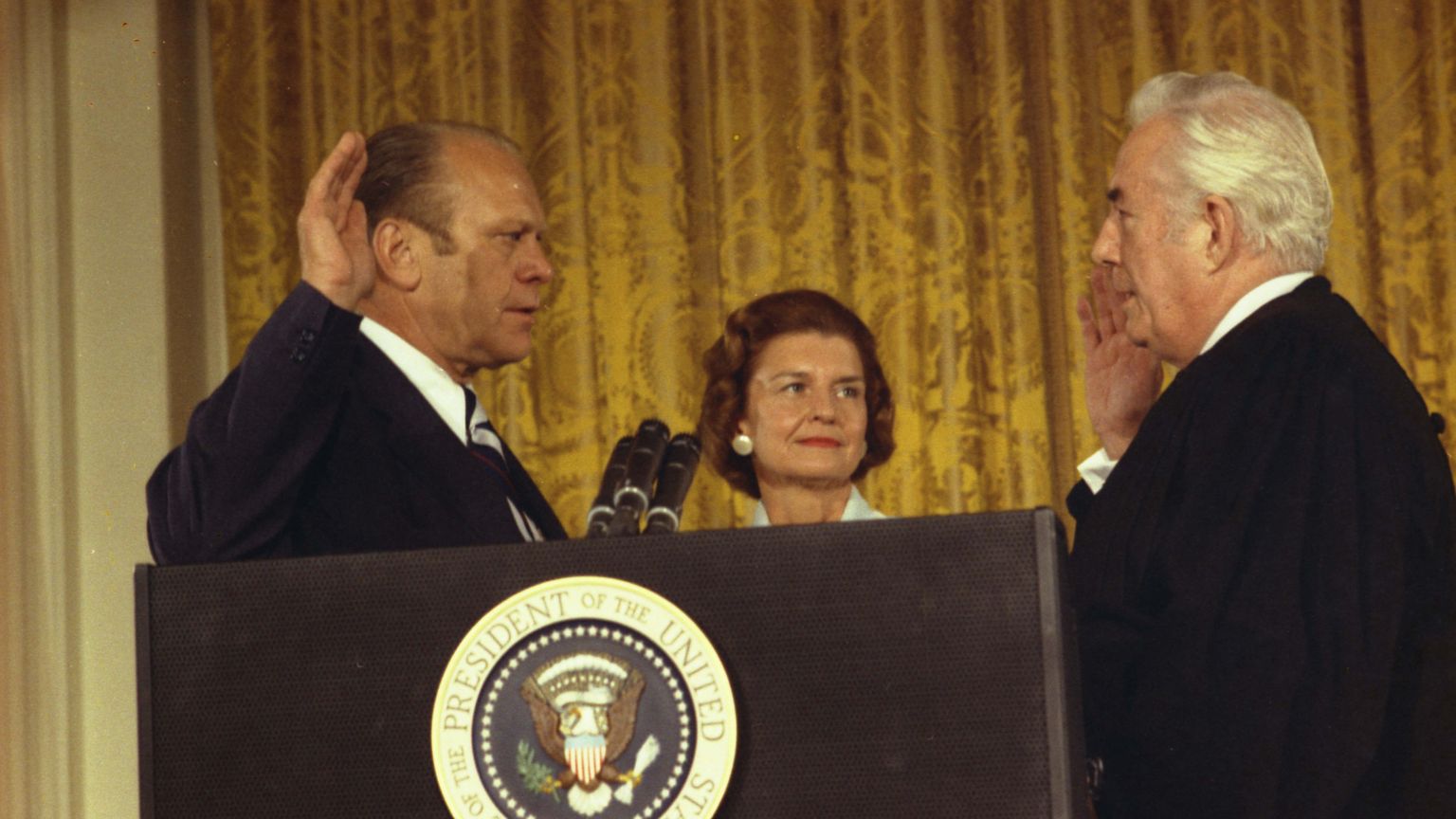
The photo above is the Ford case. Ford had become Vice President in December 1973 through Section 2 of the 25th Amendment, after the previous Vice President resigned. When Nixon resigned on August 9, 1974, Ford took the oath that day under Section 1. He is the only person who served as both Vice President and President without being elected to either office.
Who comes after the Vice President?
If there is no President and no Vice President, a federal law, the Presidential Succession Act of 1947 (3 U.S.C. 19), sets the order of who would act as President:
- Speaker of the House (the name is Q30)
- President pro tempore of the Senate
- Cabinet secretaries, roughly in the order their departments were created: State, Treasury, Defense, Attorney General, Interior, Agriculture, Commerce, Labor, Health and Human Services, Housing and Urban Development, Transportation, Energy, Education, Veterans Affairs, Homeland Security
Every person in the line must meet the Constitution’s requirements to be President: a natural-born citizen, at least 35 years old, with 14 years of residence in the United States. A Cabinet secretary who was born a citizen of another country and later naturalized is skipped. This has happened: Secretaries of State Henry Kissinger and Madeleine Albright, both naturalized citizens, were not in the line.
So a naturalized citizen cannot be President, and, under the 12th Amendment, cannot be Vice President either. A naturalized citizen can serve in the Cabinet, in the Senate (after 9 years as a citizen) and in the House (after 7 years).
Older test vs. 2025 test. The 2008 civics test had a second question: “If both the President and the Vice President can no longer serve, who becomes President?” (answer: the Speaker of the House). The 2025 test does not have that question. If you filed your N-400 on or after October 20, 2025, Q40’s answer is only “the Vice President.” Not sure which test you’ll take? See Which civics test am I taking? 2008 vs 2025.
The President questions as one group
Q40 sits in a run of questions about the President. Learn them together:
| # | Question | Answer |
|---|---|---|
| Q36 | The President is elected for how many years? | Four (4) years |
| Q37 | The President can serve only two terms. Why? | The 22nd Amendment / to keep the president from becoming too powerful |
| Q38 | Name of the President now? | Donald J. Trump (Donald Trump, Trump) |
| Q39 | Name of the Vice President now? | JD Vance (Vance) |
| Q40 | If the president can no longer serve, who becomes president? | The Vice President |
| Q42 | Who is Commander in Chief of the U.S. military? | The President |
Q38 and Q39 change when the officeholders change, and so does Q30 (the Speaker, currently Mike Johnson). USCIS posts the current answers on Check for Test Updates. Today’s midterm election does not change the President or Vice President. The House will choose its Speaker when the new Congress meets in January 2027. More on that in the November 3 midterms and your civics test.
A note on Q37: the 22nd Amendment (1951) also says someone who served more than two years of another President’s term can be elected only once. That’s why Lyndon Johnson, who served 14 months of Kennedy’s term, could have run for two full terms. You don’t need this on the test, but it explains why the answer says “two terms.”
Traps that cost points
- Saying a name for Q40. “JD Vance” answers Q39, not Q40. For Q40, say the office: “the Vice President.”
- Saying “the Speaker of the House.” That was the answer to a 2008 question about both the President and Vice President. It’s wrong for Q40.
- Saying “the Chief Justice.” The Chief Justice (Q57) usually gives the President the oath of office but is not in the line of succession.
- Mixing up Q40 and Q46/Q47. The Vice President is also a Cabinet-level position (an accepted answer for Q48), but the Cabinet’s job is to advise the President (Q47).
30-second drill (say it out loud)
- If the president can no longer serve, who becomes president? → The Vice President.
- What is the name of the Vice President now? → JD Vance.
- How many years is a presidential term? → Four years.
- Why only two terms? → The 22nd Amendment.
- Who is Commander in Chief? → The President.
Say the office for 1, a name for 2. When you can switch between them without stopping, you know the pair.
Practice them
- Drill Q36–Q42 on the free civics practice test or take a full 20-question test.
- Hear the questions and answer out loud in Listen mode.
- More executive-branch answers: Vice President, Cabinet and Electoral College and who does what: Congress, the President and the courts.
Sources: USCIS, 2025 Civics Test, 128 Questions and Answers (PDF) (Q30, Q36–Q42, Q48, Q57); USCIS, Check for Test Updates; USCIS Policy Manual, Volume 12, Part E, Chapter 2 (2025 test for N-400s filed on or after October 20, 2025); National Archives, The Constitution: Amendments 11–27 (22nd and 25th Amendments); U.S. Constitution, Art. II §1 (presidential qualifications and succession); 3 U.S.C. 19 (Presidential Succession Act). Photo: Robert L. Knudsen / Gerald R. Ford Presidential Library, via Wikimedia Commons (public domain).
CitizenExams is an independent study site and is not affiliated with USCIS. This post is general information, not legal advice.