Where Is the Statue of Liberty? Civics Test Q120, Explained
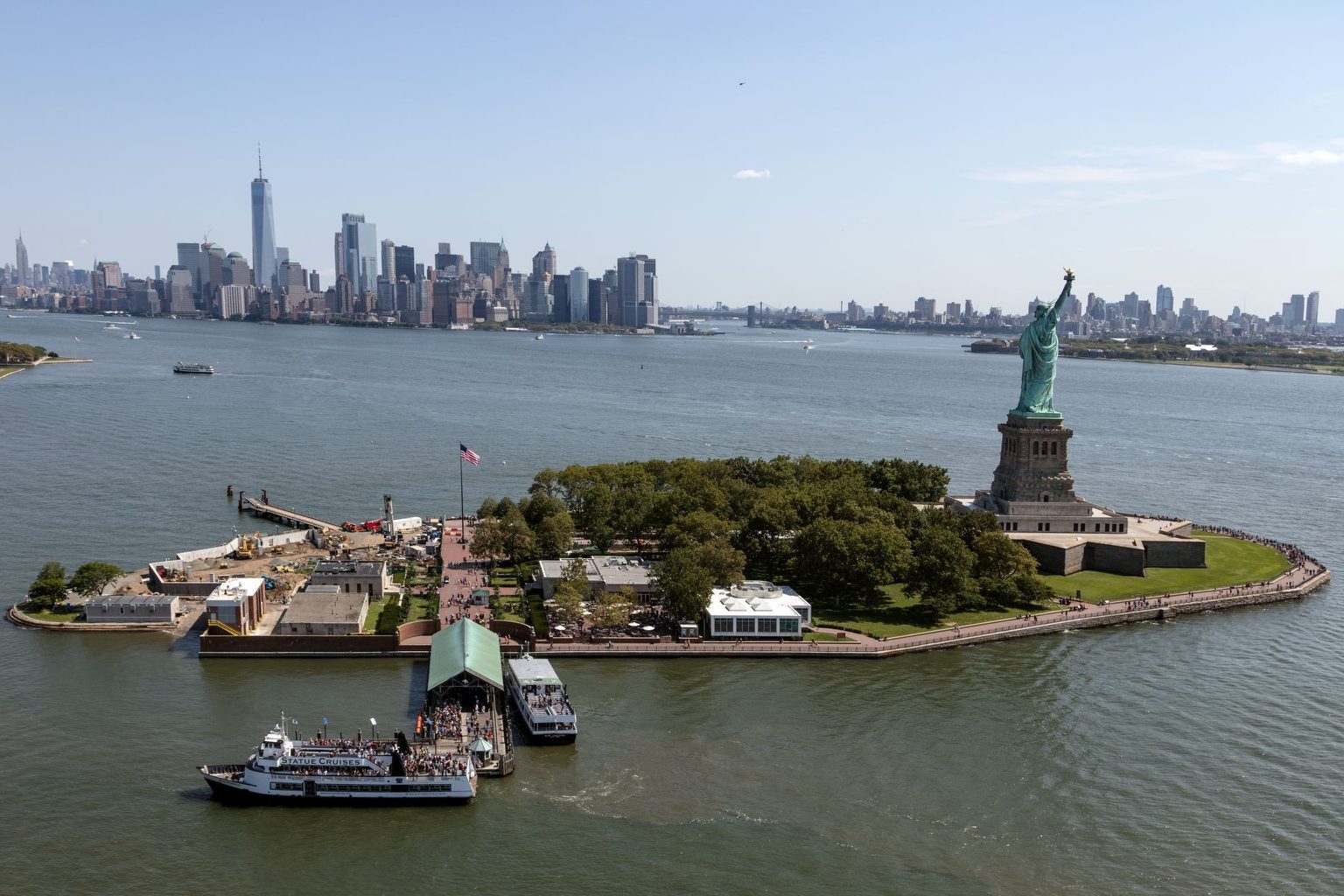
Where is the Statue of Liberty? (Q120) is one of the shortest questions in the Symbols block of the 2025 Naturalization Civics Test, and the photo above is the answer: a small island in New York Harbor, with Manhattan across the water. USCIS accepts several ways to say it, so you only need to remember one short place name.
Where is the Statue of Liberty? (Q120)
Accepted answers, from the official USCIS list:
- New York (Harbor)
- Liberty Island
- Also acceptable: New Jersey, near New York City, and on the Hudson (River)
Any one is enough. The easiest answer to say clearly is “New York Harbor” (or just “New York”). If an officer hears “Liberty Island,” that is also correct.
Why is New Jersey accepted? Liberty Island sits in New York Harbor at the mouth of the Hudson River, much closer to the New Jersey shore than to Manhattan. That is why USCIS lists New Jersey and “on the Hudson” as acceptable too. You do not need to explain this at the interview; just say one accepted answer.
A short story to remember it
These facts are study context only. On the test, just say where the statue is.
- A gift from France. The people of France gave the statue to the United States as a symbol of friendship and of liberty. The sculptor was Frédéric Auguste Bartholdi; Gustave Eiffel (of the Eiffel Tower) designed the iron frame inside.
- Dedicated in 1886. The statue was dedicated on October 28, 1886. It became a National Monument in 1924, and today the National Park Service takes care of it.
- What she holds. A torch in her right hand, for the light of liberty, and a tablet in her left hand with the date of the Declaration of Independence: July 4, 1776 (written as JULY IV MDCCLXXVI). Broken chains lie at her feet.
- A welcome to immigrants. Ships arriving in New York passed the statue. Nearby Ellis Island was the main U.S. immigration station from 1892 to 1954, and millions of new arrivals saw the statue first. Emma Lazarus’s poem The New Colossus (“Give me your tired, your poor, your huddled masses yearning to breathe free”) is on a plaque inside.
Memory trick: Liberty lives on Liberty Island, in New York Harbor. Same word, same place.
Connect it: two more Symbols questions
The capital is a different place (Q119). What is the capital of the United States? The answer is Washington, D.C., not New York. Some people mix them up because the Statue of Liberty is so famous. Keep them apart: the government is in Washington, D.C.; the statue is in New York Harbor. More in American symbols: the flag and the national anthem.
Out of many, one (Q124). The Nation’s first motto was “E Pluribus Unum.” What does that mean? Accepted answers: “Out of many, one” or “We all become one.” It fits the statue’s story: people from many countries arrived through New York Harbor and became one nation.
The statue also connects to why people came to America in the first place. The colonists came to America for many reasons. Name one (Q73): freedom, political liberty, religious freedom, economic opportunity, or escape persecution.
One-minute review
| Question | Say this |
|---|---|
| Q120 — Where is the Statue of Liberty? | New York Harbor (or Liberty Island, New Jersey, near New York City, on the Hudson) |
| Q119 — Capital of the United States | Washington, D.C. |
| Q124 — What does “E Pluribus Unum” mean? | Out of many, one (or we all become one) |
| Q73 — Why did colonists come to America? | Freedom (or political liberty, religious freedom, economic opportunity, escape persecution) |
Study these related questions
- Symbols and Holidays — A: Symbols: Q119, Q120, and Q124 in context, with audio
- American innovations (Q118): the question right before this one in the Symbols block
- National holidays on the civics test: Independence Day and the other holiday questions
- Free scored practice test: 20 questions like the interview, 12 correct to pass
This is an evergreen study post. The answers come from the official USCIS 128 Civics Questions and Answers (2025 version), used for Form N-400 filed on or after October 20, 2025 (USCIS Policy Manual, Vol. 12, Part E, Ch. 2). Not sure which test you will take? See Which civics test: 2008 vs 2025. History details are from the National Park Service: Statue of Liberty National Monument.
This post summarizes public USCIS civics materials for educational study. It is not legal advice.