Why Do Supreme Court Justices Serve for Life? Civics Q55 and Q56 in Plain English
“Supreme Court justices serve for life. Why?” is Q56 on the 2025 civics test. It comes right after Q55, “How long do Supreme Court justices serve?” Learn them as a pair: Q55 is how long, Q56 is why.
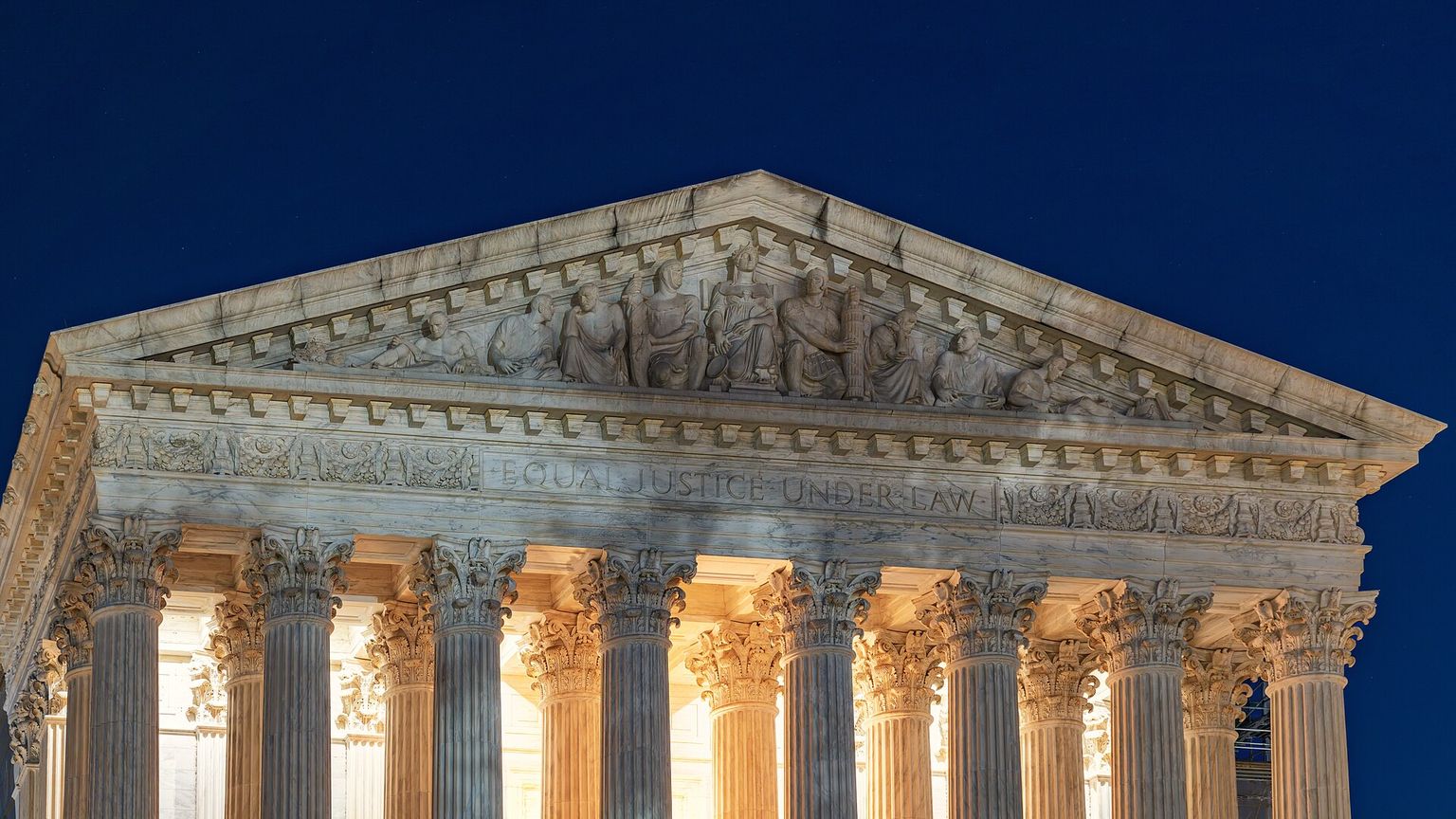
The photo shows the front of the U.S. Supreme Court Building in Washington, D.C., at dusk. The words carved above the columns, “Equal Justice Under Law,” are a good way to remember the idea behind Q56: judges should decide cases by the law, not by who is popular or powerful this year.
The answers USCIS accepts
From the USCIS list of 128 questions (PDF):
| Question | Answers USCIS accepts |
|---|---|
| Q55 How long do Supreme Court justices serve? | (For) life · Lifetime appointment · (Until) retirement |
| Q56 Supreme Court justices serve for life. Why? | To be independent (of politics) · To limit outside (political) influence |
You only need one answer for each question. The shortest safe answers are: “For life” and “To be independent.”
Neither question has an asterisk, so they are not on the short list for the 65/20 special consideration. The older 2008 test (for people who filed before October 20, 2025) has no “how long” or “why” question about justices, but it does ask for the highest court, the number of justices, and the Chief Justice (2008 Q38–Q40). Not sure which test you’ll get? See 2008 vs 2025: which civics test.
The words in plain English
| Words | Plain English |
|---|---|
| Justice | A judge on the Supreme Court. There are nine. |
| Lifetime appointment | Once the Senate confirms a justice, there is no end date. The job is theirs as long as they want it. |
| Retirement | Choosing to stop working. Most justices leave the Court by retiring. |
| Independent | Free to decide without being controlled by someone else. |
| Outside (political) influence | Pressure from the President, Congress, political parties, voters or money. |
What the Constitution actually says
The Constitution never uses the words “for life.” Article III, Section 1 says federal judges “shall hold their Offices during good Behaviour,” and that their pay “shall not be diminished during their Continuance in Office” (National Archives transcript).
In plain English, that sentence gives judges two protections:
- Their job has no end date. “During good Behaviour” means a justice keeps the job as long as they choose. The Supreme Court’s own FAQ explains that justices “hold office as long as they choose and can only be removed from office by impeachment” (Supreme Court of the United States, General FAQ).
- Their pay can’t be cut. Congress can’t punish a justice for an unpopular decision by lowering their salary.
The same rule covers all federal judges in the courts created under Article III, not only the nine justices.
Why the founders wanted it this way
Think about what a judge without these protections would face. If a justice had to run for re-election, or be reappointed by the President every few years, they might worry about their next job while deciding a case. They might rule the way powerful people want instead of the way the law says.
Alexander Hamilton explained the founders’ thinking in Federalist No. 78 in 1788 (Library of Congress, Federalist Papers full text):
- The courts are the weakest branch. The President “holds the sword” and Congress “commands the purse,” while the judiciary has “neither FORCE nor WILL, but merely judgment.”
- Because the courts are weak, they are “in continual jeopardy of being overpowered, awed, or influenced” by the other branches.
- So “nothing can contribute so much to its firmness and independence as permanency in office.”
That is Q56 in one sentence: justices serve for life so they can be independent and make decisions without political pressure. Hamilton’s essays are on the test too: the Federalist Papers “helped people understand the Constitution” (Q84). See the Federalist Papers and Benjamin Franklin.
How it connects to checks and balances
Lifetime appointments are one piece of the system of checks and balances (Q15):
- The President nominates justices, and the Senate must confirm them (Article II, Section 2).
- Once confirmed, justices don’t answer to the President or the Senate. That lets the Court decide if a law goes against the Constitution (Q51), even when the law is popular in Congress.
- Congress can still impeach a justice for serious wrongdoing. The House impeaches; the Senate holds the trial.
Only one justice has ever been impeached. The House impeached Justice Samuel Chase in 1804, mostly because his political opponents disliked how he acted on the bench. On March 1, 1805, the Senate acquitted him on every charge. The Senate Historical Office says the result “effectively insulated the judiciary from further congressional attacks based on disapproval of judges’ opinions” (U.S. Senate, Impeachment Trial of Justice Samuel Chase). In other words: you can’t remove a judge just because you don’t like their decisions.
“For life” doesn’t mean forever
This is why USCIS also accepts "(until) retirement" for Q55. A justice’s time on the Court ends when they:
- Retire (the most common way),
- Die in office, or
- Are impeached and removed (this has never happened to a Supreme Court justice).
There is no retirement age and no term limit for federal judges. In many states it’s different: state judges often serve fixed terms or face elections. That’s why Q55 asks about the Supreme Court specifically.
One idea, several questions
| Question | Answer | How it connects |
|---|---|---|
| Q50 What is one part of the judicial branch? | Supreme Court or Federal Courts | All Article III judges serve “during good Behaviour” |
| Q52 What is the highest court in the United States? ★ | Supreme Court | Starred: on the 65/20 list |
| Q53 How many seats are on the Supreme Court? | Nine (9) | Set by Congress, not the Constitution; nine since the Judiciary Act of 1869 |
| Q54 How many justices are usually needed to decide a case? | Five (5) | A majority of nine. “Usually,” because a justice can sit out a case |
| Q55 How long do justices serve? | For life / until retirement | |
| Q56 Why do they serve for life? | To be independent (of politics) | |
| Q57 Who is the Chief Justice now? | John Roberts | Check USCIS test updates before your interview |
The Supreme Court’s FAQ adds one more fact worth knowing: the first Judiciary Act of 1789 set six justices, and the number changed several times (from five to ten) until 1869, when it was fixed at nine. For the whole judicial branch in one place, see the Supreme Court on the 2025 civics test.
Common wrong answers
- “Four years,” “six years” or “two years.” No. Four years is the President’s term (Q36), six is a senator’s (Q22) and two is a representative’s (Q25). Justices have no fixed term.
- “Because the President picks them.” That’s who nominates them, not why they serve for life.
- “So they can make laws.” No. Congress makes laws. The courts review and explain laws (Q51).
- “To be powerful.” The opposite idea. The founders gave judges long terms because the courts were the weakest branch and needed protection.
- Mixing up Q55 and Q56. Q55 = how long (for life). Q56 = why (to be independent).
Say it out loud
The officer reads the question, and you answer out loud. Short is best:
“For life.”
and
“To be independent of politics.”
Many “why” questions on the test have short answers about balance and independence. See the civics test “why” questions and try practicing civics out loud.
Quick self-check
- How long do Supreme Court justices serve? Give one answer.
- Why do they serve for life? Give one answer.
- What two words in Article III give judges their lifetime job?
- Who nominates a justice, and who confirms them?
- How many justices are usually needed to decide a case?
- (For) life, a lifetime appointment, or (until) retirement.
- To be independent (of politics) or to limit outside (political) influence.
- “Good Behaviour.” Judges hold their offices “during good Behaviour.”
- The President nominates; the Senate confirms.
- Five (5), a majority of the nine seats.
Practice Q55 and Q56 with the rest of the System of Government questions in the practice test, or listen to them on the go with Listen.
Read next
- The Supreme Court on the 2025 Civics Test
- What Is the Supreme Law of the Land? Civics Q2 and the Supremacy Clause
- Checks and Balances, Explained: Who Checks Whom (Q15)
- Why Does Each State Have Two Senators? Civics Q27 and Q28
- The Numbers on the 2025 Civics Test: 27, 100, 435, 9 and More
Sources: USCIS, 2025 Civics Test, 128 Questions and Answers (PDF) (Q50–Q57; Q52 starred, Q55 and Q56 not starred); USCIS, 2008 Civics Test, 100 Questions (PDF) (Q38–Q40); USCIS, Check for Test Updates (current Chief Justice); National Archives, The Constitution of the United States: A Transcription (Article II, Section 2; Article III, Section 1); Supreme Court of the United States, General FAQ (“good Behaviour,” removal only by impeachment, Samuel Chase the only justice impeached, six justices in 1789, nine since the Judiciary Act of 1869); U.S. Senate, Impeachment Trial of Justice Samuel Chase, 1804–05 (acquitted March 1, 1805); Library of Congress, Federalist Papers, Nos. 71–80 (Federalist No. 78). Photo: Tony Webster, U.S. Supreme Court Building, via Wikimedia Commons (CC BY 2.0).
This post is general study information, not legal advice. CitizenExams is an independent study site and is not affiliated with USCIS.