What Does "We the People" Mean? Civics Q4 and the Preamble in Plain English
“The U.S. Constitution starts with the words ‘We the People.’ What does ‘We the People’ mean?” is Q4 on the 2025 civics test. The question sounds deep, but the answer is short: the people are in charge of the government. This post explains the five answers USCIS accepts, what the rest of the Preamble says, and how Q4 helps you with other questions on the list.
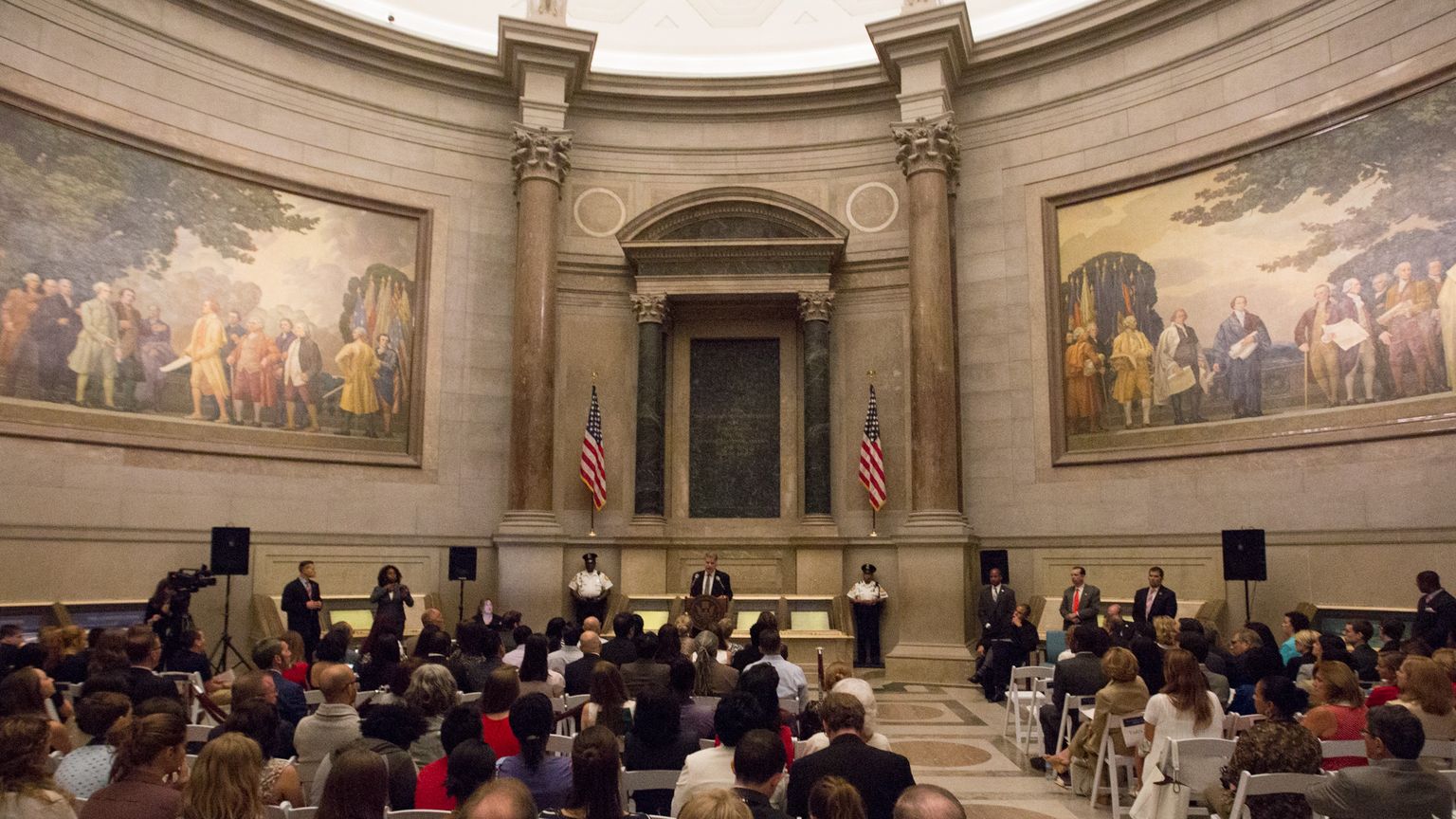
The photo shows a naturalization ceremony in the Rotunda of the National Archives on September 17, 2015, Constitution Day. The Rotunda is where the original Constitution, with “We the People” in large letters at the top, is on display.
The answers USCIS accepts
The USCIS list of 128 questions (PDF) gives five answers for Q4. Say one:
- “Self-government”
- “Popular sovereignty”
- “Consent of the governed”
- “People should govern themselves”
- "(Example of) social contract"
Easiest to remember: “Self-government” or “People should govern themselves.” If you can say “the people govern themselves” in your own words, you have the idea.
Q4 does not have an asterisk, so it is not one of the 20 questions for the 65/20 test. On the older 2008 test (for people who filed before October 20, 2025), the question is turned around. Question 3 says: “The idea of self-government is in the first three words of the Constitution. What are these words?” The answer is “We the People.” Not sure which test you’ll get? See 2008 vs 2025: which civics test.
The five answers in plain English
| USCIS answer | Plain English |
|---|---|
| Self-government | The people run their own government. No king or queen rules them. |
| Popular sovereignty | Popular = of the people. Sovereignty = the highest power. The highest power belongs to the people. |
| Consent of the governed | Consent = agreement, permission. The government gets its power because the people agree to it. |
| People should govern themselves | The same idea in everyday words. |
| (Example of) social contract | The people and the government make a kind of deal. People agree to form a government and follow its laws; the government must protect their rights. |
All five say the same thing in different words: power comes from the people, not from the government.
The whole Preamble, line by line
“We the People” are the first words of the Preamble, the one-sentence introduction to the Constitution. Here is the full text from the National Archives:
“We the People of the United States, in Order to form a more perfect Union, establish Justice, insure domestic Tranquility, provide for the common defence, promote the general Welfare, and secure the Blessings of Liberty to ourselves and our Posterity, do ordain and establish this Constitution for the United States of America.”
| Words | Plain English |
|---|---|
| We the People of the United States | We, the people (not the king, not the states alone). This is Q4. |
| in Order to form a more perfect Union | To make the country stronger and more united than before. |
| establish Justice | To make fair laws and fair courts. |
| insure domestic Tranquility | To keep peace inside the country. |
| provide for the common defence | To protect the country from attack. |
| promote the general Welfare | To help people live good lives. |
| secure the Blessings of Liberty to ourselves and our Posterity | To protect freedom for us and for our children and grandchildren. |
| do ordain and establish this Constitution | We create this Constitution. |
The Preamble does not give anyone a power by itself. It says who is making the government (the people) and why (the six goals). The seven articles after it build the government. See Civics Q3 and the 7 Articles.
Why “We the People” was a big deal
- Before 1776, the colonies were ruled by a king. Power came from the top down. One reason Americans declared independence, on the list as Q77, is that “they did not have self-government.” The Constitution turned that around.
- The Declaration of Independence said it first. It says governments get “their just powers from the consent of the governed” (National Archives transcript). That is one of the Q4 answers, word for word.
- “Of the United States,” not “of the states.” An early draft at the 1787 Convention listed the states one by one. The Committee of Style, led by Gouverneur Morris, wrote the final words “We the People of the United States” (National Archives, A More Perfect Union; National Constitution Center, The Preamble).
- The people approved it. Article VII says the Constitution took effect when conventions in nine states ratified it. Those conventions were elected for that purpose, so the people, not only the old state governments, said yes.
One answer, several questions
Learning Q4 well gives you words you can reuse:
| Question | How Q4 helps |
|---|---|
| Q1 What is the form of government? | Republic / representative democracy: the people elect leaders to govern for them. That is self-government in practice. |
| Q3 Name one thing the Constitution does | Forms the government. The Preamble says the people do the forming. |
| Q10 Two important ideas from the Declaration and Constitution | Self-government and social contract are on this list too. |
| Q77 One reason Americans declared independence | They did not have self-government. |
| Q69 Two examples of civic participation | Vote, run for office: how “We the People” govern today. |
If Q4 comes up, you can also connect it to the rest of the principles section in Principles of American Government.
Common wrong answers
- “The Constitution.” That’s Q2 (the supreme law of the land), not what “We the People” means.
- “Freedom” or “liberty.” These are good American ideas, and liberty is a Q10 answer, but they are not Q4 answers. Say self-government.
- “Only citizens.” “We the People” is about where government power comes from. It is not a rule about who counts.
- “The Declaration of Independence.” The Declaration has the idea of consent of the governed, but the words “We the People” open the Constitution.
- “Democracy.” Close, but it is not on the list for Q4. Say “people should govern themselves” instead.
Say it out loud
At the interview, the officer reads the question and you answer out loud. Practice a short, clear sentence:
“It means self-government. The people govern themselves.”
That’s enough. You don’t need to explain the whole Preamble. If you want more speaking practice, try practicing civics out loud.
Quick self-check
- Give two USCIS answers to Q4.
- What does sovereignty mean in plain English?
- Which founding document first said governments get their power from the “consent of the governed”?
- On the 2008 test, what are the first three words of the Constitution?
- Name one of the six goals in the Preamble.
- Any two of: self-government, popular sovereignty, consent of the governed, people should govern themselves, (example of) social contract.
- The highest power. Popular sovereignty means the highest power belongs to the people.
- The Declaration of Independence.
- We the People.
- Any one of: form a more perfect union, establish justice, insure domestic tranquility, provide for the common defense, promote the general welfare, secure the blessings of liberty.
Practice Q4 with the rest of the Principles of American Government questions in the practice test, or listen to them on the go with Listen.
Read next
- Republic or Democracy? Civics Q1, the Form of U.S. Government, in Plain English
- What Does the Constitution Do? Civics Q3 and the 7 Articles in Plain English
- The Pledge of Allegiance, Word by Word: Civics Q66 in Plain English
- Equality, Liberty, and the Rule of Law on the 2025 Civics Test (Q10, Q13)
- Hard Words on the 2025 Civics Test, in Plain English: A 76-Word Glossary
Sources: USCIS, 2025 Civics Test, 128 Questions and Answers (PDF) (Q1, Q2, Q3, Q4, Q10, Q69, Q77); USCIS, 2008 Civics Test, 100 Questions (PDF) (Q3, “We the People”); USCIS Policy Manual, Vol. 12, Part E, Ch. 2, English and Civics Testing (2008 vs 2025 test by filing date); National Archives, The Constitution of the United States: A Transcription (Preamble, Article VII); National Archives, The Declaration of Independence: A Transcription (“consent of the governed”); National Archives, A More Perfect Union: The Creation of the U.S. Constitution (Committee of Style, Gouverneur Morris); National Constitution Center, Interactive Constitution: The Preamble. Photo: U.S. National Archives, via Wikimedia Commons (public domain).
This post is general study information, not legal advice. CitizenExams is an independent study site and is not affiliated with USCIS.