Who Does What? Congress, the President, and the Courts on the 2025 Civics Test
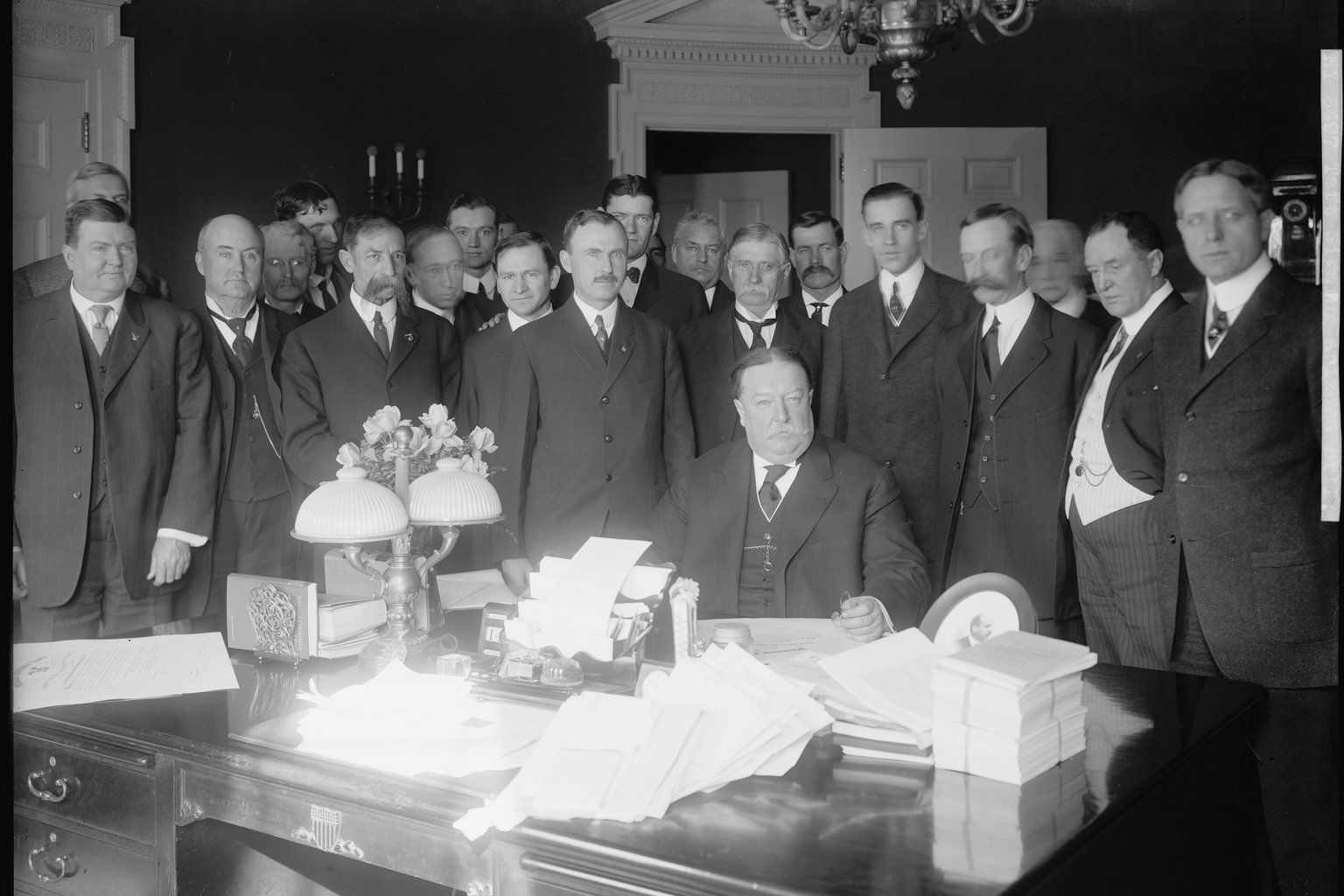
A common mistake at the naturalization interview is knowing the right action but giving it to the wrong branch, such as saying Congress signs bills or the Supreme Court writes laws. This post sorts the 2025 Naturalization Civics Test questions about powers by who does it, using the exact accepted answers. The photo above shows the job described in Q43: President William Howard Taft at his desk in 1912, in a picture the Library of Congress titles “Signing Arizona Bill.”
Congress writes the laws
Q18 — What part of the federal government writes laws? Accepted: (U.S.) Congress; (U.S. or national) legislature; Legislative branch.
Q20 — Name one power of the U.S. Congress. Accepted (any one): Writes laws; Declares war; Makes the federal budget.
Remember the three Congress powers as laws, war, and money.
The President signs, vetoes, enforces, and appoints
Q17 — The President of the United States is in charge of which branch of government? Accepted: Executive branch.
Q41 — Name one power of the president. Accepted (any one): Signs bills into law; Vetoes bills; Enforces laws; Commander in Chief (of the military); Chief diplomat; Appoints federal judges.
The next four questions all have the same answer: The President (of the United States).
- Q42 — Who is Commander in Chief of the U.S. military? The President.
- Q43 — Who signs bills to become laws? The President.
- Q44 — Who vetoes bills? The President.
- Q45 — Who appoints federal judges? The President.
If a question starts with “Who signs,” “Who vetoes,” “Who appoints,” or “Who is Commander in Chief,” the answer is the President. Notice that Q41 and Q43–Q45 overlap: the powers in Q41 are the same jobs those questions ask about.
The courts explain and review the laws
Q50 — What is one part of the judicial branch? Accepted: Supreme Court; Federal Courts.
Q51 — What does the judicial branch do? Accepted (any one): Reviews laws; Explains laws; Resolves disputes (disagreements) about the law; Decides if a law goes against the (U.S.) Constitution.
The easy way to keep them apart
| Branch | Who | Short job |
|---|---|---|
| Legislative | Congress | Writes the laws (also declares war, makes the budget) |
| Executive | The President | Signs or vetoes bills and enforces the laws |
| Judicial | Supreme Court and federal courts | Reviews and explains the laws |
One sentence that ties it together: Congress writes a bill, the President signs or vetoes it, and the courts decide if it goes against the Constitution. That one line also explains why there are three branches (Q15: so one part does not become too powerful).
Quick self-check
Cover the right side and answer out loud:
- Who declares war? Congress (Q20)
- Who vetoes bills? The President (Q44)
- What does the judicial branch do? Reviews laws (Q51)
- Who appoints federal judges? The President (Q45)
- What part of the federal government writes laws? Congress (Q18)
Then take a free scored practice test (20 questions, 12 correct to pass on the 2025 path), or drill this section in American Government → System of Government. Coming back for a short session a few times a week works better than one long cram.
Study these next
- The Three Branches of Government
- Congress: House and Senate
- Vice President, Cabinet, and Electoral College
- The Supreme Court
- The 19 “Why” Questions on the 2025 Civics Test
This is an evergreen study post. Answers come from the official USCIS 128 Civics Questions and Answers (2025 version), used for Form N-400 filed on or after October 20, 2025 (2025 Civics Test). Photo: Harris & Ewing, Library of Congress.
This post summarizes public USCIS civics materials for educational study. It is not legal advice.