Why Did the U.S. Enter Each War? Five "Why" Answers for the Civics Test
Veterans Day is Wednesday, November 11. It is also a civics test answer (Q128: a holiday to honor people who have served in the U.S. military), and it is a good week to learn the five history questions that ask why the United States went to war.
These five questions look alike, and that is the problem: applicants mix up the answers. Learn them as one set and you will not.
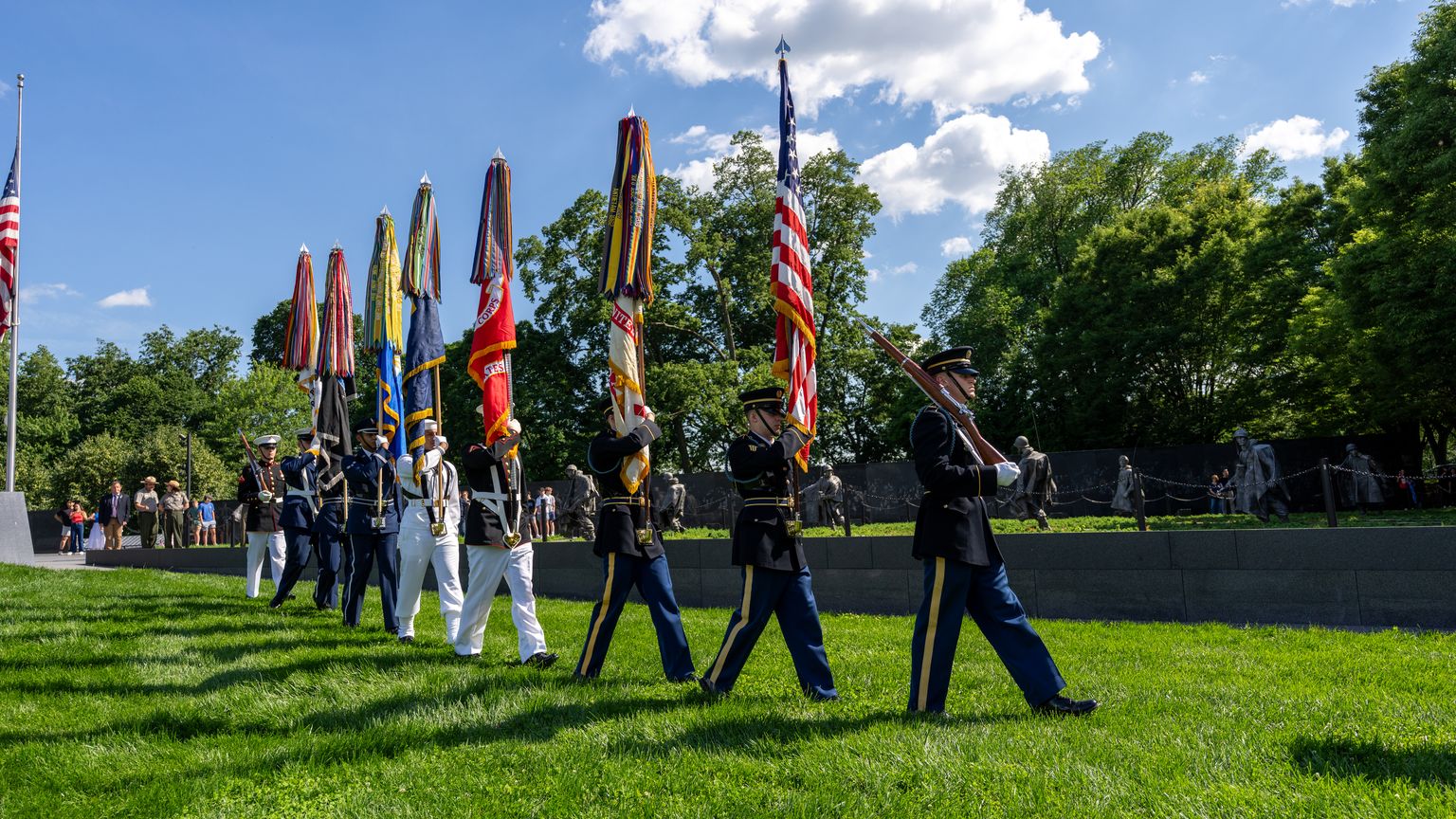
The photo shows the Joint Armed Forces Color Guard at a wreath-laying ceremony at the Korean War Veterans Memorial in Washington, D.C., in May 2025.
The five “why did the U.S. enter” questions
| Question | Accepted answers (2025 test) |
|---|---|
| Q101. Why did the United States enter World War I? | Because Germany attacked U.S. (civilian) ships · To support the Allied Powers (England, France, Italy, and Russia) · To oppose the Central Powers (Germany, Austria-Hungary, the Ottoman Empire, and Bulgaria) |
| Q106. Why did the United States enter World War II? | (Bombing of) Pearl Harbor · Japanese attacked Pearl Harbor · To support the Allied Powers (England, France, and Russia) · To oppose the Axis Powers (Germany, Italy, and Japan) |
| Q110. Why did the United States enter the Korean War? | To stop the spread of communism |
| Q111. Why did the United States enter the Vietnam War? | To stop the spread of communism |
| Q114. Why did the United States enter the Persian Gulf War? | To force the Iraqi military from Kuwait |
You only need one accepted answer for each. The bold answer is the shortest one to say out loud.
A memory trick: two attacks, two “communism,” one Kuwait
Put the five wars in time order and the answers fall into a pattern:
- World War I and World War II: the U.S. was attacked. In World War I, German submarines attacked American ships. In World War II, Japan attacked Pearl Harbor in Hawaii on December 7, 1941.
- Korea and Vietnam: the Cold War. Both answers are the same: to stop the spread of communism. This connects to Q108 (the main Cold War rival was the Soviet Union) and Q109 (a main Cold War concern was communism or nuclear war).
- The Persian Gulf War: Kuwait. Iraq invaded its neighbor Kuwait in 1990, and a U.S.-led coalition forced the Iraqi military out in early 1991.
So the short version is: ships, Pearl Harbor, communism, communism, Kuwait.
The mix-ups to avoid
- Pearl Harbor is World War II, not World War I. If the officer says “World War I,” think ships. If you hear “World War II,” think Pearl Harbor.
- Communism is the answer for Korea and Vietnam only. It is not the answer for the Gulf War. For the Gulf War, the key word is Kuwait.
- Allies vs. Axis. “Axis Powers” belongs to World War II. “Central Powers” belongs to World War I. If those names are hard to keep apart, use the short answers instead (ships for World War I, Pearl Harbor for World War II).
- September 11 is a different question. Q116 asks you to name a U.S. military conflict after the September 11, 2001 attacks: the (Global) War on Terror, the War in Afghanistan, or the War in Iraq. It does not ask why.
The “name one war” question
Q100 asks you to name one war the United States fought in the 1900s. All five wars in the table above are accepted answers, because all five were fought in the 1900s: World War I, World War II, the Korean War, the Vietnam War, and the (Persian) Gulf War. If you learned the five “why” questions, you already know five answers to Q100.
Wars from the 1800s (War of 1812, Mexican-American War, Civil War, Spanish-American War) belong to a different question, Q91. Our post on U.S. wars on the civics test puts all of them on one timeline.
A 2-minute Veterans Day drill
Say each answer out loud, then check yourself:
- Why did the United States enter World War I? Because Germany attacked U.S. ships.
- Why did the United States enter World War II? Pearl Harbor.
- Why did the United States enter the Korean War? To stop the spread of communism.
- Why did the United States enter the Vietnam War? To stop the spread of communism.
- Why did the United States enter the Persian Gulf War? To force the Iraqi military from Kuwait.
- What is Veterans Day? A holiday to honor people who have served in the U.S. military.
Then mix the order. The officer will not ask them in sequence, so practice hearing “Korean War” or “World War I” in the middle of other questions. The free practice test shuffles questions for you, and the Listen mode reads them aloud. You can also practice this whole block in Recent American History.
Read next
- U.S. Wars on the 2025 Civics Test: From the War of 1812 to the Gulf War and 9/11
- The 19 “Why” Questions on the 2025 Civics Test (With Short Answers)
- Cold War and Communism on the 2025 Civics Test
- Veterans Day and Citizenship: The Military Civics Questions and How Service Members Naturalize
Sources: USCIS 2025 civics test questions and answers; U.S. Department of Veterans Affairs: History of Veterans Day; National Archives: Joint Address to Congress Leading to a Declaration of War Against Japan (1941). Photo: 3d U.S. Infantry Regiment (The Old Guard), via Wikimedia Commons (public domain).
CitizenExams is an independent study site and is not affiliated with USCIS.